
If there is one lesson the era of turbo-hybrid Formula 1 cars has taught us, it is how important and complex the role of the flow meter is. Limiting the amount of fuel the cars could carry, as well as its flow rate, forced manufacturers to innovate to improve combustion efficiency – making this instrument the vital enforcer of those limits.
From 2026, with the arrival of new power units with a different split of electrical and internal combustion power, this component will undergo a profound evolution – not only in how measurements are taken but also in terms of the supplier.
After years in which Sentronics equipped every car with two flow meters – one for the teams and one encrypted for the FIA – the supply will pass to Allengra, the company that won the tender for the new technical cycle. This is a responsibility of the highest order, because some of the most sensitive parameters in Formula 1 pass through the flow meter – especially in light of the controversies in 2019, which prompted the FIA to specify a second meter for every car.
Precisely for this reason, a more advanced and functional unit was needed. Among the key developments has been the consolidation of the two separate meters – one dedicated to the teams and the other one encrypted and only accessible by the FIA – within one device in a suitably compact form factor.
Why the new flow meter is significantly more advanced
“One could say they are like two units in one. A major advantage is that the pipes have a different geometry, which makes it mechanically difficult to synchronise them perfectly at the same instant, even when using the same measurement frequency,» says Niels Junker, co-CEO of Allengra, speaking exclusively to Autosport.
Photo by: Erik Junius
«However, we use different measurement frequencies on the two pipes, combined with anti-aliasing functions, so the teams cannot synchronise with the frequency.»
This architecture makes it much more challenging for teams to circumvent the purpose of the flow meters. The two pipes through which the fuel flow runs have different geometries, providing a first level of protection that makes it mechanically difficult for teams to synchronise the measurements.
Added to this is a second level: each pipe uses its own measurement frequency, further protected by anti-aliasing functions that prevent any signal alignment.
The two units, in fact, do not monitor the flow at the same frequency, since it varies over time. This is a crucial aspect: even if, hypothetically, a team managed to synchronise with the frequency of its own flow meter, it could not replicate that of the other unit, which remains encrypted and accessible only to the FIA in real time. The result is a multi-level security system designed to prevent any attempts to synchronise with or manipulate the recorded values.
A system that measures 6,000 times per second
The Allengra flow meter operates between 4 and 6kHz, roughly three times faster than current sensors. This means the measurement process is repeated up to 6,000 times per second.
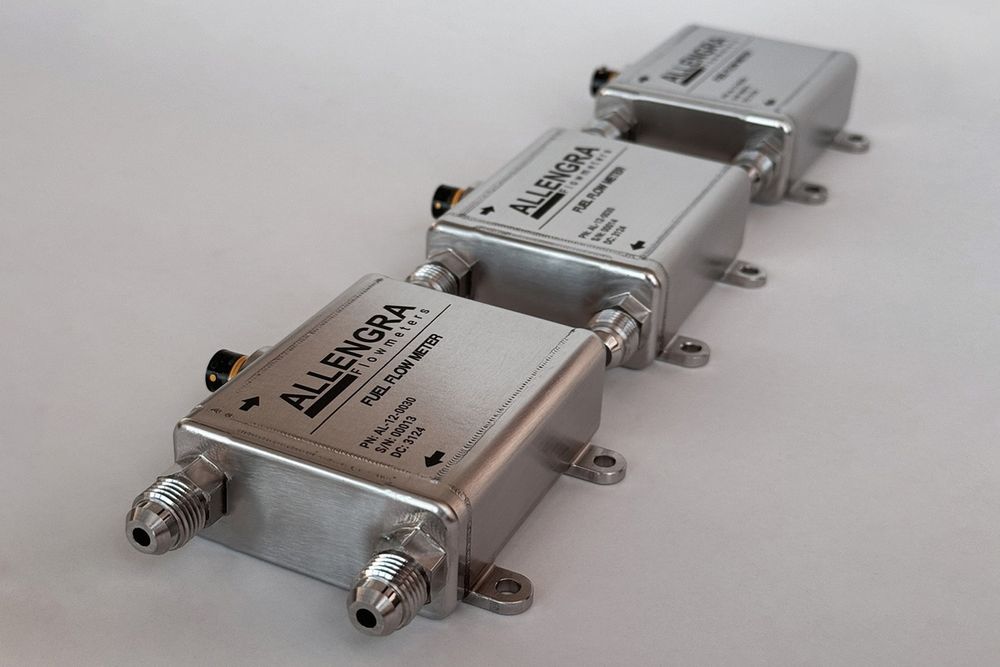
Flussometro F1 2026 di Allengra
Photo by: Allengra
Such a fast system cannot be calibrated with a conventional Coriolis sensor – often used by teams in the factory – which operates at 300Hz. For this reason, Allengra has developed its own in-house 20kHz ultrasonic reference sensor, capable of validating the measurements obtained.
The system has already been validated through several on-track tests in 2025. Within the heart of the unit is essentially a flattened “U”-shaped structure: the fuel enters from one side, follows a predefined path, and exits from the other.
Along this path, two opposing ultrasonic transducers are positioned, exchanging a signal. The “time of flight” the signal takes to travel through the system and reach the other transducer is the key parameter: under static conditions, the system has all the necessary parameters to determine how long this journey should take.
However, when the fuel flows through the system, the situation changes: the flow accelerates the signal in the direction of travel, like a boat being carried by the waves – and slows it down in the opposite direction when it’s moving against the current, as it were. By measuring the difference between the two transit times and knowing the distance between the transducers, the system is able to precisely determine the velocity of the fluid.
From this, knowing the internal diameter of the pipe, the volumetric flow rate is obtained. But the system doesn’t stop at volume, which can vary with temperature and operating conditions. For this reason, mass is measured instead.
Through a specific calibration for each type of fuel, which takes into account factors such as the fluid’s density and the speed of sound within it, the flow meter derives the mass flow rate, the regulatory parameter expressed in kilograms per hour. In 2026 this limit will drop to just over 70 kg/h, reducing fuel consumption.
This fuel flow-rate figure is fundamental, but it represents just one aspect of how the flow meter will contribute from this season onwards. The Allengra sensor will continue to measure mass flow, but also monitor an additional control parameter at the behest of the FIA.
Energy value becomes the key parameter
From 2026, the Federation will also verify the energy flow rate of the fuel fed into the engine. The characteristics of each fuel and its respective energy values per unit of mass will be certified by a third, independent body before arriving at the track. This means there will no longer be just a flow meter tasked with calculating mass flow in kg/h, but a more complex system that will then measure the total energy flow of the fuel.
In essence, the value obtained from the flow meter in kg/h will be converted by the engine’s ECU (also a homologated component from a single supplier) into fuel energy flow using the fuel’s energy density and lower heating value, certified by a third party, according to procedures set out in an FIA document specific to each fuel. Overall, the final value must not exceed 3000 MJ/h. For example, below 10,500 rpm, the permitted energy flow must not exceed that calculated using the formula EF (MJ/h) = 0.27 × N (engine speed in rpm) + 165.
What does all this imply? That, depending on the quality of the fuel developed by each manufacturer, differences may emerge in the mass flow required to reach the fixed limit of 3000 MJ/h. In other words, the energy content of the fuel will become a strategic variable: if a fuel is more energy-dense, a smaller mass will be needed to achieve the same energy flow.

Photo by: Mark Sutton / Motorsport Images
This also translates into a potential advantage in terms of on-board weight. A manufacturer that succeeds in developing a fuel with higher energy density will be able to carry fewer kilograms of fuel while still supplying the engine with the same required amount of energy.
This is one of the many reasons why a development race is brewing between the fuel suppliers. But it’s only the first part of the story…
We want to hear from you!
Let us know what you would like to see from us in the future.
— The Autosport.com Team


