
Earlier this month, Toyota Racing revealed the refreshed TR010 Hybrid, featuring a next-generation aerodynamic update designed to make its Le Mans Hypercar more competitive.
The result is a prototype with a front end that looks completely different from what we’ve become accustomed to seeing since the LMP1 era.
Toyota was the first to present its hypercar in 2021, then called the GR010 Hybrid, and certain design elements — starting with the headlights — strongly echoed the previous generation of prototypes. Now, being the oldest car on the grid, a drastic update was needed to allow it to return to fighting for success and keep pace with the times.
“Fixing Problems, Creating Identity”
«What we have been targeting is to address a few issues we have seen during racing in the last few seasons,» Toyota’s technical chief David Floury told media including Motorsport.com.
«So, the current 2025 aero package actually is the same as raced in 2023 and 2024, so it has been used for three seasons.
«We wanted to address a few small issues we had seen with this package and generally make the car easier to drive and more consistent in all conditions, so that was the target.
«The second target, which is also new to the 2026 car, was to integrate much more styling identity, so that the car is representing the brand’s image more accurately and strongly.»
Step by step, Toyota’s engineers rolled up their sleeves to understand how and where to intervene on the GR010 Hybrid. The first obstacle was naturally dictated by the regulations, which are no longer as free as in the LMP1 days, but are now well understood so teams can work within the permitted limits.
«The first thing to consider is that Hypercar is regulated based on an aero performance window, which is used for all cars as part of the homologation process,» he explained.
«All cars are tested in a full-scale wind tunnel going through the same maps and they have to, with weighted average on all the map points, enter an aero homologation window, which has a tight range of track and downforce.
«Therefore, it is a very different approach than in the LMP1 days, because now we are not developing to either reduce drag or increase downforce or maximise aero efficiency, but we have to satisfy this aero window.»
Floury noted that while the LMP1 regulations were heavily geometry-based and allowed broader freedom in bodywork, LMH rules tightly control the end results.
«The means to achieve the performance is still somehow constrained. But the new thing is that the final performance is also constrained, measured and regulated,» he said.
«Therefore, it is a very different approach to LMP1. In LMP1, you would not be constrained either by tight homologation and limited evolution.
«In those years, we were developing every year either a new car or multiple aero packages. It was a development race, bringing evolution also during the course of the season.
«Now, it is more about trying to develop a car that is consistent, user-friendly and being able to maximise the performance within this window in all conditions.»
Toyota TR010 Hybrid
Wind tunnel challenges and delayed upgrade
Another challenge came with the restructuring of the Sauber wind tunnel, which had been used by the FIA for European homologations. Once refurbished, its primary use shifted to the Audi Formula 1 programme, forcing everyone else to find alternative facilities.
The FIA then decided to conduct the new homologation at Windshear in the United States, which is already used by IMSA, inevitably forcing every team to revise their plans and schedules — both for introducing new cars and for upgrading existing ones.
Toyota was also unsure if the FIA and the ACO would allow it to introduce a substantial upgrade to the car after it had won the 2024 manufacturers’ title. Both governing bodies must approve any use of evo jokers as part of the regulations.
«The decision to do the aero update was taken in the course of 2024 to try and keep up with the development pace,» he revealed.
«We were initially targeting the introduction for the 2025 season, but due to the wind tunnel change from Sauber to Windshear, due to the Sauber [wind tunnel] being now used by Audi, we could not achieve [the] 2025 [target date].
«Due to the change in wind tunnel, all the 2025 cars had to be homologated in Sauber before December [2024], which was impossible to achieve or would have led to too big a compromise, both in terms of performance, styling and quality of what we were doing.»
Even within the constrained aerodynamic window, Toyota found ways to refine elements such as top speed — but the scope for improving aerodynamic drag was heavily limited by the rules.
Birth of the TR010 Hybrid
Revisions to the front end, certain side profile lines and a different rear wing configuration ultimately led to the creation of the TR010 Hybrid — a new name driven both by the aerodynamic changes and the desire to align with the team’s updated branding as Toyota Racing (with Gazoo Racing focusing on rallying and other programmes), while still remaining faithful to the base design of the original project.
In recent seasons, the car was also significantly impacted by the notorious Balance of Performance system, which limited its ability to counter certain constraints as it once could. This made it even more necessary to revisit key aspects to remain competitive in all conditions.
Toyota spent one evo joker on the upgrades.
» I don’t have the [mileage] figure from the top of my head, but we had four testing days,» Floury said. «[Apart from aero] we have made some small updates, which are more linked to reliability than anything else.
«Obviously, we have had a couple of small things during last year, the biggest one being losing a wheel at Le Mans, and these points we needed to address.
«With a very competitive environment of WEC nowadays, if you want to win races and championships, you need to be perfect in all aspects. Even so, losing a wheel in Le Mans was an issue that was caused by a combination of factors.»
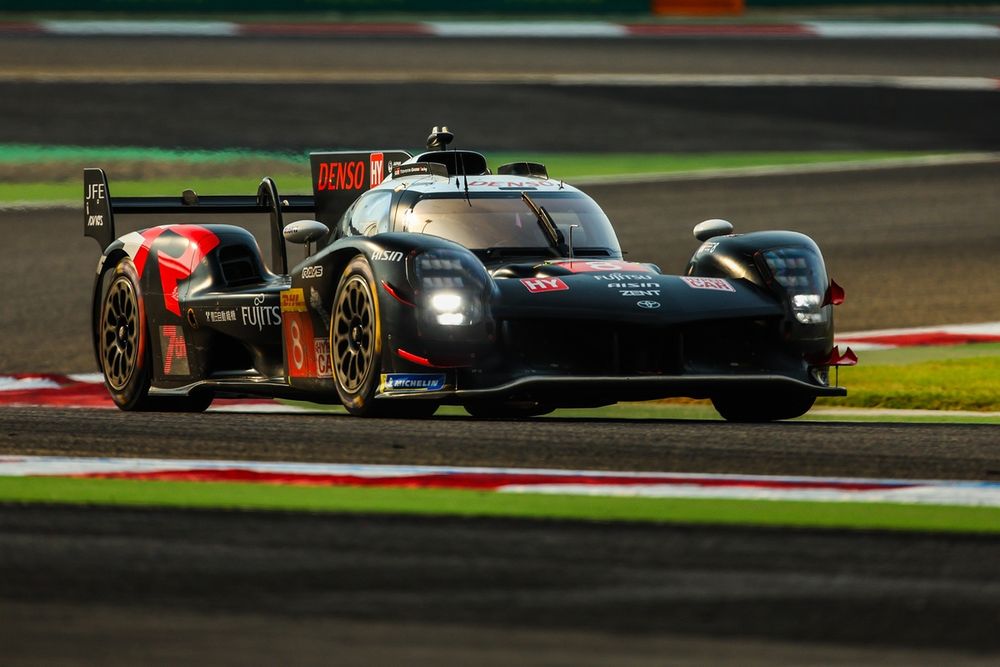
#8 Toyota Gazoo Racing Toyota GR010 — Hybrid: Sebastien Buemi, Brendon Hartley, Ryo Hirakawa
Photo by: AG Photo — Daniele Paglino
One of the primary goals of the redesign was for the TR010 Hybrid to carry a much stronger Toyota identity, which is now evident thanks to the styling work from the design department in Japan.
Of course, compromises were necessary: some stylistic elements were too penalising aerodynamically and could not be used; other aerodynamic solutions were compromise the style of the car far too much. Finding the right balance between the two led to the final homologated solutions.
Le Mans in Sight
Finally, the obsessive focus remains Le Mans. Toyota hasn’t won the blue riband round of the WEC since 2022 — and the black “rage” livery used for two consecutive years was tied to that quest. With the TR010 Hybrid, Toyota’s sights are once again firmly set on the French endurance classic, with even more firepower to bring to the fight.
«At the end of the day, why we go racing is to win a race championship, and obviously Le Mans is a big target,» he said.
«After that Le Mans is also one of the most challenging races, probably the most challenging one in terms of endurance racing or circuit racing, and it is also now a very competitive environment.
«It’s a challenge but we are up for the challenge and we are aiming to achieve this.»
We want your opinion!
What would you like to see on Motorsport.com?
— The Motorsport.com Team


