
When Andrea Stella addressed the media on Friday evening in Bahrain, he shared something in addition to his first impression of the new pecking order: McLaren had tested so-called super clipping up to the full 350 kilowatts that day.
Super clipping is, put simply, the state in which the 2026 cars can harvest energy while the driver is at full throttle. It sounds attractive for the ‘energy-poor’ F1 cars under these new regulations, but it comes at a certain price – above all, lower top speed. While super clipping, not all of the power goes directly to the rear wheels; part of it is stored via the MGU-K for deployment later.
How is super clipping visible in the data?
Super clipping mainly occurs at the end of the straights and in high-speed corners, which ties in closely with the comments made by some F1 drivers.
When Fernando Alonso said in Bahrain that he could pull the chef out of the Aston Martin kitchen to drive the car, he was referring specifically to Turn 12. A look at the data confirms that this is one of the spots where drivers were frequently harvesting under super clipping and where they – despite being at full throttle – were losing speed as a result of it.
It can also be seen in the image below, which compares Oscar Piastri’s fastest lap on Thursday with Lando Norris’ fastest lap on Friday. On the latter day, McLaren tested super clipping up to a 350kW limit instead of 250kW.
The speed profiles of both laps differed considerably despite an almost identical lap time – a difference of 0.010s. Piastri reached higher top speeds on the straights towards Turns 1, 4 and 14 during Thursday’s lap. In all cases, both drivers were at full throttle all the time, which suggests that Norris was using more super clipping in those parts of the track on Friday, which aligns with McLaren’s increased super clipping test that day.
However, the roles were reversed in Turn 12. Telemetry shows that both drivers were again at full throttle, yet Piastri’s speed at that point was around 20kph lower. At that specific corner, the Australian was the one using super clipping to harvest energy. The significant speed effect of it explains why Alonso said the 2026 cars can be 50kph slower in fast corners and that a chef could drive them – although it must be said that the figure he mentioned represents the most extreme case.
Photo by: GP Tempo
Could increasing super clipping be a good plan B?
Under the 2026 regulations, the energy that can be harvested via super clipping is currently limited to 250kW of the total 350kW. However, following what he described as a successful test, Stella argued for raising that limit to the full 350kW.
“At the moment it’s limited to 250 kilowatts, but all the conditions are there to make this 350 kilowatts harvest while the driver is full throttle, which means that the driver doesn’t have to lift and coast to harvest 350 kilowatt,” the McLaren team principal said. “So we discussed this with the FIA and it will ultimately be up to the FIA to decide whether they introduce it or not. We successfully tested it today and we are happy.”
It is one of the options available to the FIA should the opening races prove problematic and drivers be forced into too many “unnatural things” in terms of energy management. In theory, the governing body could choose to reduce the share of electrical power in race trim to 250kW – lowering peak power but leaving drivers less energy-poor at the end of the straights – or indeed increase the super clipping for harvesting to the full 350kW.
FIA single-seater director Nikolas Tombazis did not want to go into specific plans during winter testing, but he did hint that both levers could be adjusted if necessary.
“There will always be potentially different solutions for qualifying and for the race, but I don’t want to pre-empt that because that’s the discussion we can be having,” he said. “Of course, there are people with different opinions, and I don’t want to imply in any way that we’re going for a fixed route. We are open to the suggestions of the teams and so on.”
It is important to note that any proposal regarding super clipping seems easier said than done. First, there have been suggestions that it may not be equally easy to implement for all power unit manufacturers – Honda, for instance – and second, any intervention is closely linked to the competitive picture.
Under the current regulations, efficiency in energy management is an important performance differentiator. Those who hold an advantage over the competition might therefore not be keen on any call for change. Both reducing the permitted deployment in race trim and increasing super clipping for harvesting would make the grid less energy-poor. But those who are just slightly more efficient than some of their rivals would lose part of their competitive advantage in that scenario.
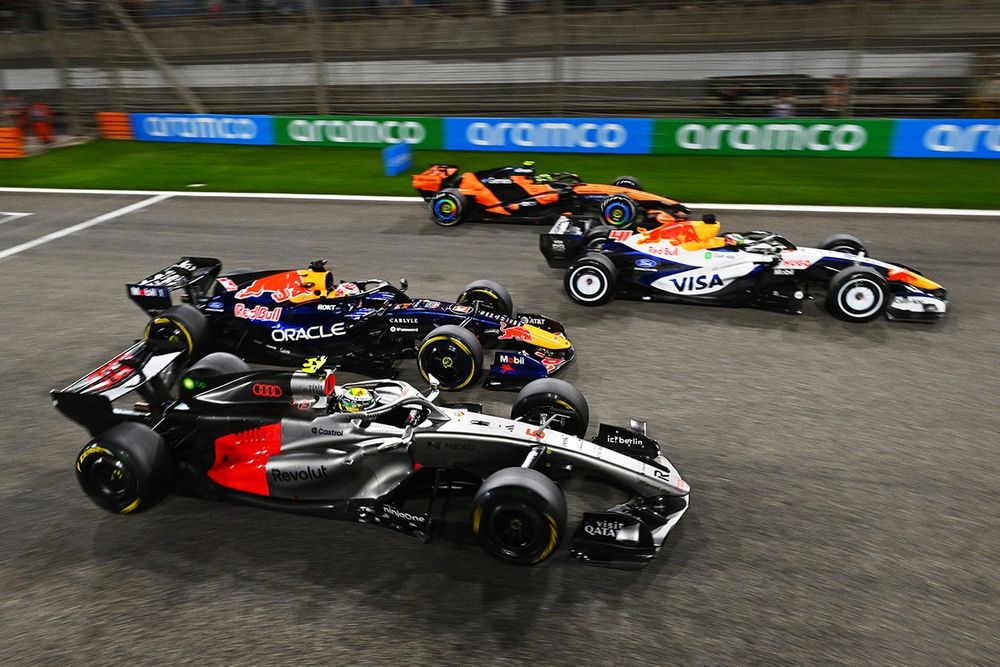
Lando Norris, McLaren, Max Verstappen, Red Bull Racing, Gabriel Bortoleto, Audi F1 Team, Arvid Lindblad, Racing Bulls
Photo by: Mark Sutton / Formula 1 via Getty Images
The impact also varies from track to track. The Bahrain International Circuit is what Stella described as a harvesting-rich circuit. There, drivers were largely able to recover energy under braking and during partial-throttle phases, meaning there was little need for unnatural lifting elsewhere.
On circuits such as Melbourne and Jeddah, however, the picture may be different due to a lack of heavy braking zones and slow-speed corners. In theory, increasing super clipping could help to prevent unnatural lift and coast and make the overall picture more attractive for fans. But on exactly those kinds of circuits, teams and manufacturers with greater efficiency may also be able to gain a bigger advantage – one they may not be willing to give up easily.
FIA wants to assess the opening races before acting
If this discussion does materialise – should the early races prove underwhelming – the question will be what prevails: the interests of the series as a whole or the sporting interests of individual teams and manufacturers. Tombazis has previously indicated that these factors can potentially clash.
“When teams and manufacturers discuss these matters, they think of a combination of the good of the sport and the good of their own competitive position,” he explained. “And of course, one bit influences the other bit. So unavoidably, there will be some different opinions.”
In any case, the FIA does not want to act hastily. The governing body first wants a clearer picture based on the opening races to determine whether intervention is needed at all and, if so, in what way.
“We are learning as we go along. And the first real test will be the first race, because here they’re not really racing each other and so on. These changes do need a bit of discussion. There may be a few weeks of discussion, and we also need to go through the governance process.
“It’s unlikely to be something between Australia and China, for example. But it’s also not months and months. We will see where we are. We will calibrate our systems, and if necessary, we will present the proposals to the teams and to the PU manufacturers.”
We want to hear from you!
Let us know what you would like to see from us in the future.
— The Autosport.com Team


