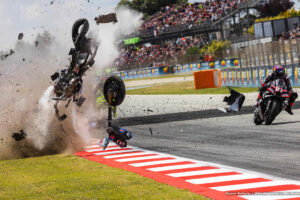
The drivers had been saying it loud and clear since the very first test: it was only a matter of time before an accident like the one involving Oliver Bearman and Franco Colapinto occurred at the Japanese Grand Prix, with the Haas driver crashing into the barriers at 50G. The accident was caused by the significant difference in speed between the British and Argentine drivers, which was also a consequence of how the new rules work.
With a fixed amount of recoverable energy per lap, each manufacturer has its own approach to deployment – deciding where and how to use and recharge the battery – which can lead to significant differences between the various teams. This is one of the reasons behind the incident, as Haas and Alpine were operating on different strategies in that section before the Spoon curve.
In fact, in the previous laps, Alpine had tended to be more aggressive in cutting power and MGU-K, doing so earlier than both those ahead – namely the Racing Bulls, one of the teams with the highest top speeds – and those behind, in this case Bearman.
Differences in energy usage between Alpine and Haas
Essentially, due to the operating performance of the power unit designed to optimise energy usage and recharging opportunities during the lap, the electric motor on Colapinto’s car began providing less support earlier on, to the point where he even had to downshift, thus approaching Spoon with a lower top speed than his rivals, at times by as much as 20km/h.
This was something Bearman had noticed and wanted to capitalise on, surprising Colapinto before the Alpine could unleash its energy to defend itself on the long straight leading to the final chicane. There is also another factor to consider: on the lap in question, the Argentine had failed to stay within a second of Arvid Lindblad ahead of him, meaning he would not have had overtake mode available, limiting his energy recovery.
All these factors combined to highlight just how risky the new rules can be in certain situations. Knowing he had an advantage in terms of energy deployment in that section of the track, Bearman attempted the attack, activating the energy boost that allows the MGU-K’s 350 kW to be used for longer by draining the battery.
Oliver Bearman, Haas F1 Team car after his crash
Photo by: Kym Illman / Getty Images
This meant that the speed gap seen in previous laps increased considerably, reaching as much as 45 km/h according to FIA data. “It’s not Colapinto’s fault; at that point, he was consistent. It’s just that we were using more energy in that area; even in the previous laps, we had a 20km/h advantage,” explained Ayao Komatsu, Haas boss, after the race. “That’s why he wanted to give it a go. He used the boost, and that created a speed difference of 50 km/h.”
In effect, it’s as if a Formula 1 car were racing against a Formula 2 car, but it’s also somewhat the crux of these regulations. Having such a powerful MGU-K guarantees a clear power surplus, particularly when the defending driver no longer has electric support, but it comes with risks.
In effect, a dynamic emerged in which Bearman was approaching from behind at a significantly higher speed, while up front Colapinto could rely solely on the internal combustion engine, as the electric unit had already stopped delivering power and wasn’t even recharging. Knowing he had to defend his position, the Argentine tried to close the line just as Bearman was setting up the overtake.
A manoeuvre that in other circumstances would still have been considered within the limits, albeit a little late, but what the Argentine could not have foreseen was such a significant difference in speed. As Bearman tried to avoid him, he ended up on the grass, lost control of the car and crashed into the barriers. Fortunately, the Englishman suffered only a grazed knee, with no fractures.
It’s difficult for drivers to anticipate such a large speed difference
“It was really strange to be honest, I was a little sitting duck. I think the speed difference is so big and so large. It’s almost like you’re in an out-lap and another guy is in a push. It’s really odd. It’s a corner that we are doing flat and he was like more than 50km/h quicker than me,” said the Alpine driver, who had been warned moments earlier over the radio that Bearman would attempt an attack.
“I think it gets really sketchy when the straights are not straight and he’s turning because we are not on a straight lane, we are kind of turning. I think it’s things to review in the future because sometimes it’s a bit dangerous. Especially when you don’t get the idea of how much quicker the other car is because there is no way of us knowing. We look in the mirror once and suddenly the other car has gone past you already. You get a bit lost with that.”
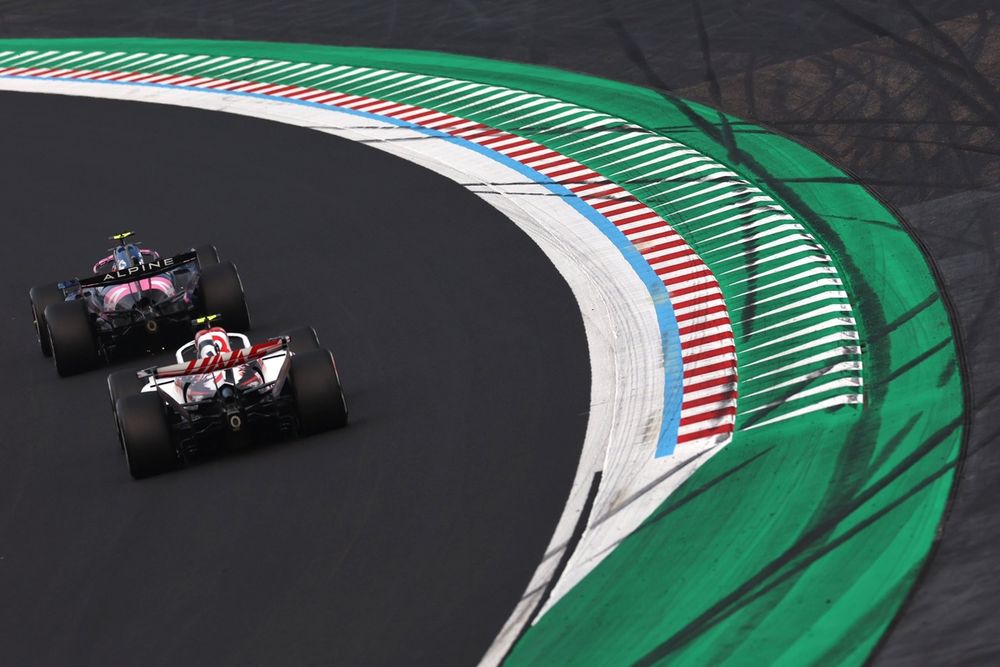
Franco Colapinto, Alpine, Oliver Bearman, Haas F1 Team
Photo by: Alastair Staley / LAT Images via Getty Images
Such large speed differentials in a battle had never been seen before, and so it is difficult for the drivers to assess the situation in real time, especially during a duel.
“’Error’ is a big strong word, to be honest. You could say small misjudgement, but just, it’s scary though, that closing speed. When I look on the GPS lap before, you know, it’s totally understandable and the correct decision to go for it there, but it’s just huge,” Komatsu said.
“This is only the third race in this regulation, so that’s something he’s never experienced. So I don’t even call it ‘error’, you know. It’s just something I think we should be aware as an F1 community and maybe see what we can improve to mitigate that, because it could have been a lot worse, right?”
It’s an issue that’s been discussed for some time, because it’s no secret that the boost is far too effective if the other driver has little energy or finds themselves without electric motor support, but the incident is the spark that will push the teams and the FIA’s to take the drivers’ words into account to prevent such huge speed differences.
In a lengthy statement, the FIA has confirmed that it will assess the situation together with the teams: a meeting will be held in mid-April to discuss how to amend the rules, starting with qualifying, but this could become another item on the agenda.
We want to hear from you!
Let us know what you would like to see from us in the future.
— The Autosport.com Team