
The cancellation of the April grands prix in Bahrain and Saudi Arabia due to the conflict in the Middle East reshaped the 2026 Formula 1 calendar. The double withdrawal left a one-month gap without races, while also creating several issues regarding how to reorganise the second half of the championship.
Formally, the two events have never been officially cancelled by Formula 1, which merely clarified that they would not take place in April. It is no secret that the shared objective remains to reschedule them later in the season. Much will depend on how the conflict in the Middle East evolves and how quickly it ends, but several options remain on the table. This is also in part because the promoters themselves are eager to recover the races.
This was confirmed by Liberty Media CEO Derek Chang, who during a recent shareholders’ meeting dedicated to presenting financial results explained that F1 leadership is “working day and night” to recover at least one of the two races.
«We will be thoughtful in our approach, and we will continuously evaluate the calendar this year. It might be possible to reschedule one race toward the end of the season,» Chang said.
In the most optimistic scenario, one of the two events – Bahrain or Saudi Arabia – could be reinserted into the calendar by using the free slot between Baku and Singapore in September. At the moment, this is the most realistic option because it would not require major calendar changes, although it would create three consecutive triple-header stretches in the final part of the year, further increasing the human and logistical burden.
The picture becomes more complicated if the goal is to recover both races. From the end of October onward, F1 will move to the Americas, leaving no room to reintroduce a race in November. It would be easier to add an event at the end of the season, when the championship already returns to the Middle East, but this solution also comes with several complications.
The Bahraini flag flies atop the Sakhir tower
Photo by: Sam Bagnall / Motorsport Images
By contract, Abu Dhabi must remain the final race of the season, meaning that adding another grand prix would require postponing the championship finale by a week, pushing the calendar even closer to the Christmas break. It should also be remembered that after the Yas Marina race, the teams are scheduled to remain in the Middle East for several days for a Pirelli testing session aimed at gathering data for 2027.
Not only would the calendar become longer, but it would also create an unprecedented sequence of four consecutive races alongside Las Vegas and Qatar, making an already exhausting period even more demanding – especially because several team members are not subject to rotation. It is easy to understand why this remains more of a background option for now, even though the financial return would strongly incentivise the teams themselves.
All of this is based on the most favourable scenario – namely that the conflict could end relatively quickly. However, the situation remains extremely volatile, and it cannot be ruled out that even the Qatar and Abu Dhabi races at the end of the year could be called into question if no international resolution is reached.
On that front, however, F1 has already confirmed that it has a backup plan, also to avoid reducing the number of grands prix too drastically, which would trigger a domino effect.
«We have plans, of course,» said F1 CEO Stefano Domenicali. «The lead time or the cutoff is different between the fact that we can eventually recover what has not been run in April versus what could eventually happen or not happen at the end of November, beginning of December.
«We are, of course, aligning with the teams, with the promoters, because that’s something that has a big chain reaction. In due time we will keep everyone informed.»
The organisational issue: Alternative hubs must be found
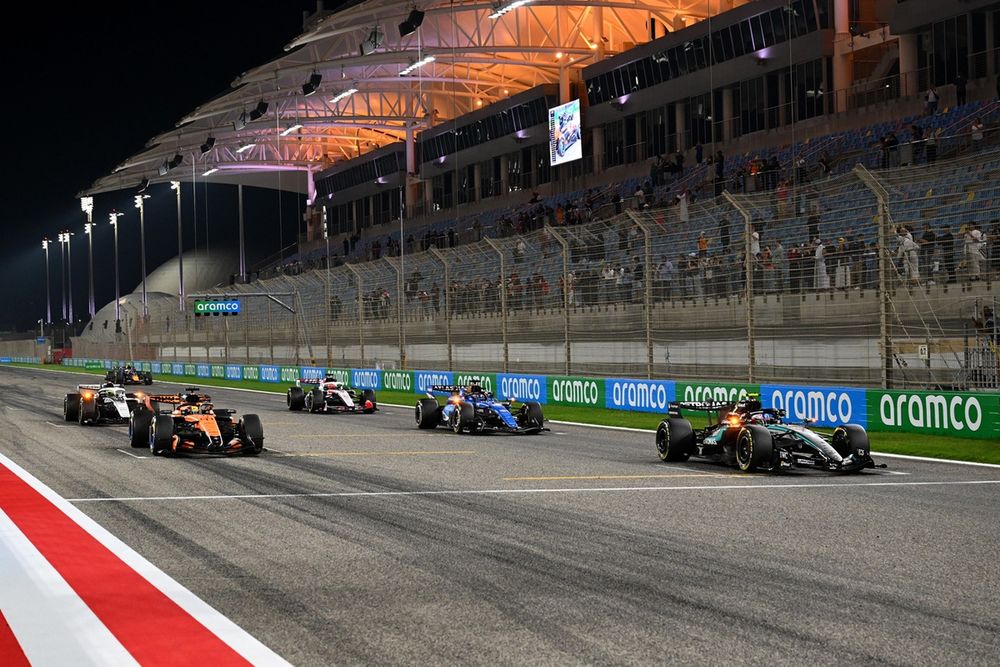
Oscar Piastri, McLaren; Andrea Kimi Antonelli, Mercedes; Esteban Ocon, Haas F1 Team; Alexander Albon, Williams; Sergio Perez, Cadillac Racing
Photo by: Mark Sutton / Formula 1 via Getty Images
But more than a timing issue, the organisational side is far easier said than done. Because of the conflict, both the teams and Pirelli – which was conducting a test session when the first missiles fell – still have equipment stranded in Bahrain, where pre-season testing had taken place.
The biggest problem is that the Middle East represents a crucial logistical hub for all teams. From Dubai or Doha – partly due to partnership agreements with F1 – materials destined for Asian flyaway races are routed through the region. The situation already forced teams to find alternative solutions ahead of the Japanese Grand Prix, which was separated in time from Australia and China.
For this reason, looking at the calendar, Singapore is the most difficult round to manage in the second half of the season, both for freight and personnel. The uncertainty surrounding the conflict’s evolution could force teams to reorganise all travel logistics, identifying alternative solutions that guarantee safety and efficiency.
The cost issue: Freight transport counts toward the budget cap
‘Efficiency’ is precisely the key word. Under the regulations, hotel costs, flights, taxis, and buses exclusively linked to travelling personnel are excluded from the budget cap. The opposite applies to freight transport: shipping costs for equipment fall within the spending limit and therefore weigh directly on team finances.
The conflict has already caused expenses to soar, and the need to find alternatives to traditional transport hubs creates further cost increases, with an even heavier impact on smaller teams.
«The freight costs have actually gone up,» explained Haas head of car engineering, Hoady Nidd. «For the smaller teams, that becomes more of a hit because the freight costs are no different for us than they are for a bigger team. And they represent a larger part of our budget.
«And now we’re obviously looking at the rest of the year and what it might mean. There’s also knock-on effects, not just with air freight, but I know that our logistics department have been working really hard on sea freight. There was obviously a lot of sea freight in Bahrain, in Saudi, and it’s a challenge to try and get those bits out of there at the moment.»

The Singapore Grand Prix remains one of the most complex races to organize for the teams
Photo by: Lionel Ng / Motorsport Images
These factors help explain why reinserting one of the two grands prix between Baku and Singapore – already considered a major logistical challenge – would still not be simple.
Each team has multiple freight kits travelling by sea according to planned destinations, but reintroducing one of the two races would require the entire planning process to be reconsidered, reallocating structures to an unscheduled round.
This is manageable when several months’ notice is available, but becomes much more complicated without clear reference points. Added to this is the issue of materials that need to move from one grand prix to another. For sustainability reasons, there is a precise shipping chain that must be respected, to the point that for many teams, containers (including chassis) returned to the factory at least a week late after the Japanese GP.
The personnel issue: It would be more than a brutal workload
Finally, there is another issue, much more delicate because it concerns the human side.
Top teams generally have more personnel, allowing them to organise frequent rotations. Smaller teams are in a different situation: resources are more limited, rotations are harder to implement, and adding another race would further increase workload and stress.
Moreover, not all team members are rotated. While systems have been created in recent years for roles such as mechanics to cope with the growing number of races on the calendar, there are positions – such as race engineers assigned to drivers, specialist engineers, sporting directors, or personnel managing trackside operations – that must always be present.
To give an idea, adding another race would bring the second half of the season to 12 events in just 16 weeks, and those required to attend every race would remain away from home for nearly four months.
A brutal stretch by any standard – technically and emotionally – especially at the end of the season.
We want to hear from you!
Let us know what you would like to see from us in the future.
— The Autosport.com Team


