
The Monza 6 Hours, which closed out the 2026 World Endurance Championship, raised more than a few questions about Race Control’s handling of the situation following the accident that occurred just 90 seconds before the finish between Alex Lynn’s #12 Cadillac and Malthe Jakobsen’s #94 Peugeot.
The two cars, battling for a top-five finish, made contact coming out of the Roggia, and the Cadillac slammed into the right-hand barriers, then bounced to the other side at a narrow section of the circuit, with debris and pieces of the billboards covering the track surface.
Since the wreckage of the Jota team’s LMDh lay just a few meters from where other cars were passing — and with the driver (fortunately unharmed) still trapped in the cockpit, awaiting a safe way out — most insiders immediately expected an obvious race neutralisation, at least a Full Course Yellow to force approaching cars to slow down.
Race Control, however, did not see it that way and chose to display the double yellow flags between the two turns. And this is where major concerns arose, since with some battles still underway — most notably the one between Richard Lietz’s Porsche and Dudu Barrichello’s Aston Martin for the LMGT3 class victory — the risk of further unfortunate incidents was high.
On the other hand, everyone wondered what might have happened if two other cars had been involved in the same accident at that spot, or if Lynn himself had needed assistance from the track crew? Or, worse yet, if another car had experienced a brake failure right at the Roggia braking point….
In short, these are various possibilities that most of the drivers Motorsport.com interviewed emphasised and highlighted, noting that a Full Course Yellow (FCY), a Safety Car, or a red-flag suspension of the race would have been more appropriate solutions in such a situation.
But what prompted Race Control to let the race continue without any neutralisation measures? Let’s try to explore some possibilities by looking at the situation from the other side of the fence, in order to understand what viable options might have been available — keeping in mind that in these contexts, every decision has pros and cons that inevitably become the subject of multiple evaluations.
#12 Cadillac Hertz Team Jota Cadillac V-Series.R: Norman Nato, Will Stevens, Alex Lynn
Photo by: AG Photo
Easing off the gas
It’s worth noting that in the aforementioned incident, the decision made by Eduardo Freitas — WEC Race Director — was not incorrect under the regulations. When double yellow flags are displayed, all drivers must slow down enough to be able to stop if necessary.
Furthermore, the track signage is supplemented by an onboard signalling system, as well as by radio communications. Therefore, the Portuguese official chose to rely on the professionalism of those directly involved in driving at that moment.
In fact, Freitas trusted the judgment of those behind the wheel at that moment, believing them capable of respecting the double yellow flags by recognising the dangerous situation and easing off the gas where and when necessary. In support of this, we can note that of the 27 cars on the track at that moment, only Esteban Masson (ASP Lexus) was penalised with 40 seconds added to his race time for overtaking at the Roggia section.
Differences in circumstances
Let’s now discuss another factor that played an important role: the time on the clock. The accident occurred 90 seconds before the checkered flag. If it had happened a few hours before the end, the race would undoubtedly have been neutralised to clear the track and remove the Cadillac, which naturally could not have remained just a few metres from the cars’ path for so many laps.
It therefore stands to reason that, quite simply, there would not have been enough time, nor would it have been necessary, to bring in emergency vehicles to attend to the stranded V-Series.R.
Ending the race with a red flag would have been the most logical choice, for obvious reasons, but we’ve known for years that the federations’ objectives are geared toward preventing races from ending behind the Safety Car or with a train of cars under the FCY, except, of course, in cases of force majeure.
As important as the spectacle is in any type of race—and as unfair as it may be from a sporting standpoint to end it prematurely without a real need— it is necessary to add that allowing everyone to continue battling would be a double-edged sword for Race Control, which would be taking on a significant risk by jeopardising safety and everything else that follows.
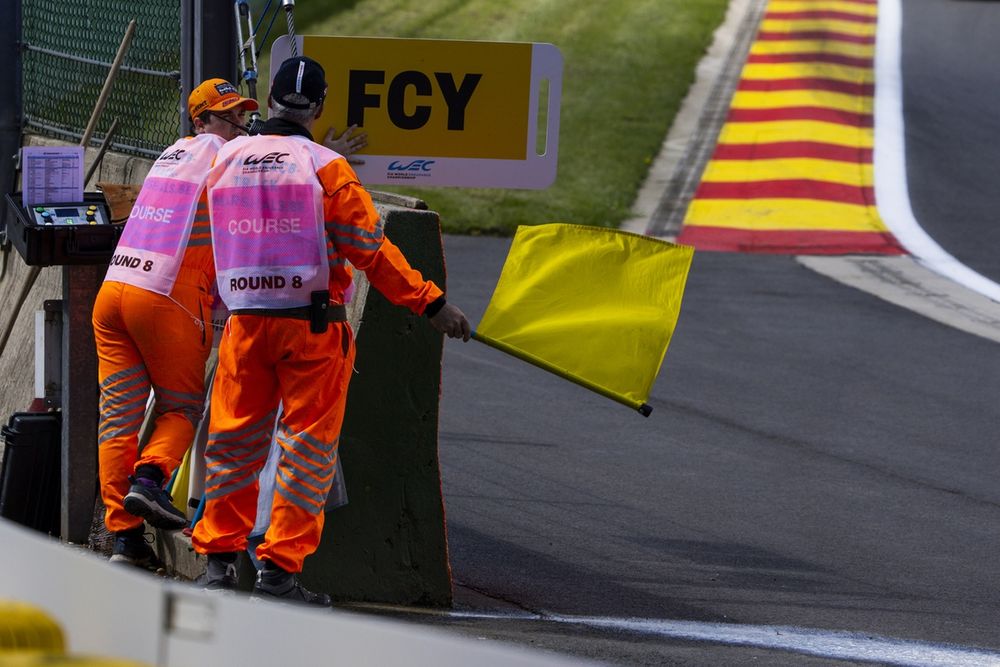
Full Course Yellow
Photo by: FIAWEC — DPPI
Safety and responsibility
The first fundamental principle upon which every race is organised and conducted: safety. This is an essential aspect for everyone, coordinated by Race Control in collaboration with the Stewards, the track marshals, and, above all, the drivers. This is why meetings are held at the start of the event (briefings), which competitors are required to attend and sign off on; during these sessions, they listen to the Race Director’s instructions on how to behave in every situation during the competition.
The rest is up to the drivers themselves, who must know what these signals mean and what to do in the event of radio announcements or flag signals along the track. This is a relationship based on trust—both verbal and formalised in writing (upon obtaining a license, by committing to abide by the rules)—that must never be betrayed. Race Directors, in an effort to avoid constant interruptions, thus demonstrate their trust in the drivers themselves, holding them accountable for their conduct.
The whole process is thus a set of behaviors designed to ensure that everyone involved performs their respective duties to the best of their ability, guided by trust and competence — even though the decisions made by the race official may be subject to criticism and subjective judgment, and are therefore made with a fair amount of courage, on a case-by-case basis.
This is also dictated by the fact that the regulations sometimes contain grey areas open to interpretation, which often place Race Control in the difficult position of having to face harsh criticism, complaints and accusations—as happened at Monza on Sunday.
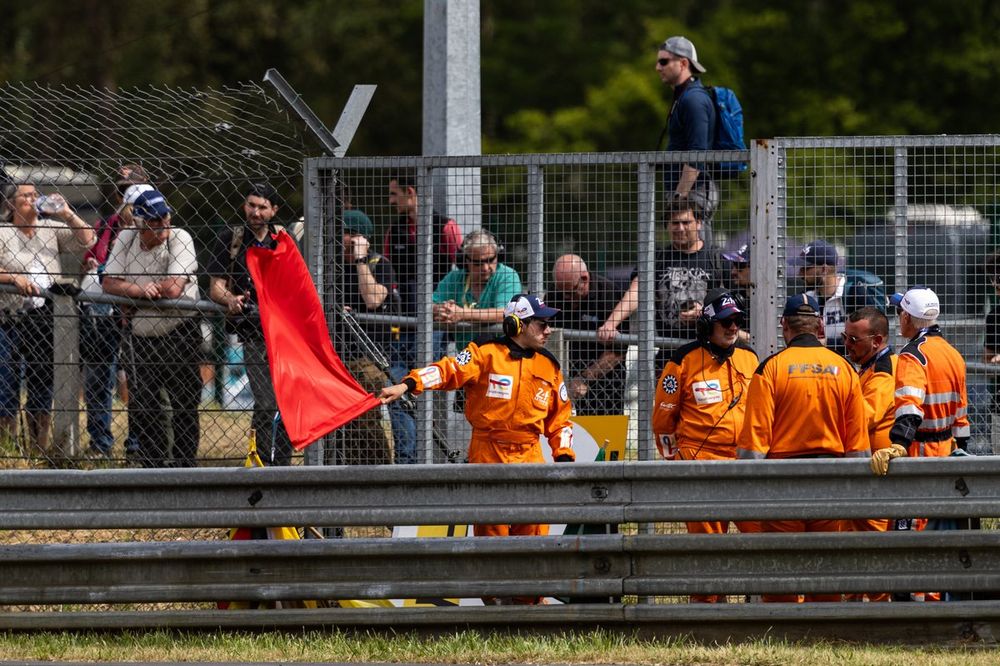
Red flag
Photo by: Alexander Trienitz
Lessons to learn
While some drivers who questioned the lack of intervention at Monza had their own vested interests, many raised their concerns purely on safety grounds.
The key point is that decisions on whether to deploy an FCY or Safety Car should be based on consistent principles. The timing of an incident should ultimately have no bearing on the type of intervention.
While race control might argue that there wasn’t sufficient time to recover Lynn’s car before the race ended, there was significant debris on track that needed to be cleared immediately.
The Monza controversy has reopened a wider debate about how the race direction responds to incidents during the race.
There have been several instances this season in which teams felt that double yellow flags or an FCY would have been sufficient to deal with an incident, only for race control to deploy a VSC, which then automatically leads to a full safety car period.
The absence of clear guidelines on when an incident warrants double yellow flags, an FCY or a Safety Car has effectively left teams and drivers guessing.
Race control’s decision to take the opposite approach at Monza has only added to that uncertainty.
«There’s never really like a set [guideline] like, ‘this situation’s happened, we’ll deploy this, this is happening, we’ll deploy that’,» Aston Martin’s Harry Tincknell told Motorsport.com ahead of Monza.
«So, there’s a little bit of guesswork involved and that makes it interesting as well from the strategist’s side. It keeps everyone on their toes.
«For sure, it’s a little bit more variable compared to IMSA where you know it’s just going to be a yellow and what the procedure is and you can get laps back there. Whereas here, it’s super important to stay underneath that.»
Race direction’s job is far from simple. Ultimately, they are the ones with a direct line to marshals and access to multiple CCTV feeds, ensuring they are best-placed to judge a situation.
The WEC has also made efforts to ensure races remain fair for teams in case of big accidents, ensuring that a VSC period allows all cars to pit before the Safety Car is deployed.
Nevertheless, the Monza incident has highlighted the need for more standardised procedures and greater transparency from race control, both towards teams and the wider public.
We want your opinion!
What would you like to see on Motorsport.com?
— The Motorsport.com Team