
In the same week it confirmed a five-year plan to win the world championship by 2030, Audi has announced a driver development programme which will scout and nurture young talent from karting through the single-seater ladder, and perhaps ultimately to Formula 1.
The move places Audi in the mainstream of F1 teams, the majority of which operate similar schemes with varying degrees of structure. With the exception of Nico Rosberg, every world champion for the past 16 years has passed through a works team’s talent-management machinery – although Sauber, the team Audi has bought, gave Raikkonen his F1 break after only a handful of car races.
Le Mans winner, former F1 driver and Audi stalwart Allan McNish will oversee the new programme, which the company describes as a «significant strategic move» with the purpose of «reinforcing the brand’s long-term commitment to building a competitive and sustainable Formula 1 team by investing in young talent, on and off the track».
Historically, Red Bull has been the biggest investor in young drivers. Its scheme, superintended until his retirement by Dr Helmut Marko, has traditionally been run on a hard-nosed up-or-out basis, yielding many casualties but producing two world champions: Sebastian Vettel and Max Verstappen (though it only facilitated Max’s final steps up the ladder).
Alpine, in its previous incarnation as Renault, was among the first teams to offer a structured talent-management facility, overseen by Flavio Briatore, which ushered 2005 and 2006 drivers’ champion Fernando Alonso into F1. Grand prix winners of the calibre of Robert Kubica and Oscar Piastri have also passed through its programme.
Seven-time champion Lewis Hamilton, like Rosberg, enjoyed the tacit support of McLaren through karting – but Hamilton then had more explicit backing from the Woking-based team through single-seaters, including an intensive testing programme before graduating to F1 in 2007.
Podium: Race winner Lewis Hamilton, McLaren
Photo by: Rainer W. Schlegelmilch / Motorsport Images
«To be entrusted with finding the cornerstones of the future Audi F1 Team is a great honour and a responsibility I am very passionate about,» said McNish.
«This brand is built on a history of ‘Vorsprung durch Technik’, and that philosophy must apply to our young drivers as much as to our cars. We are not just looking for raw speed; we are looking for the resilience, intelligence, and team-driven mindset that defines a future Audi champion.
«Our goal is to build a pathway that turns potential into precision and performance on the world stage. I am thrilled to begin this work and identify the first generation of talent to join this ambitious project.»
Before the days of F1 junior teams, McNish dovetailed a Formula 3000 race programme with testing duties for McLaren and Benetton in the early 1990s. When an opportunity in F1 failed to arise he swapped to sportscars with aplomb, winning the 1998 Le Mans 24 Hours with Porsche before being headhunted by Toyota in its bid to make its fast but fragile GT-One a winner.
Though that car failed to match pace with sufficient reliability to cross the finishing line in first place, it earned McNish a brief call-up to Toyota’s F1 effort in its first season. Separately, a relationship with Audi which began in 2000 netted him two further Le Mans wins, four Sebring 12 Hours victories, and three American Le Mans Series championships.
After hanging up his helmet he remained with Audi in an advisory role and became team principal when the company entered Formula E.
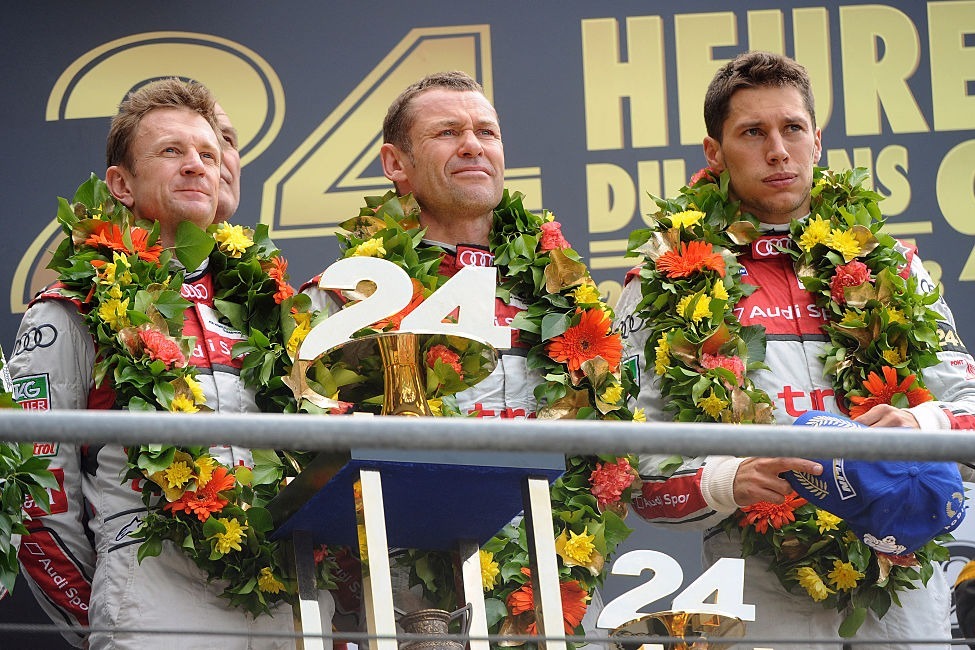
Allan McNish (left, with Tom Kristensen and Loic Duval) claimed his third Le Mans victory in 2013
Photo by: Getty Images
We want to hear from you!
Let us know what you would like to see from us in the future.
— The Autosport.com Team


