
The overall classification of the Dakar Rally remains tight, with the top-seven drivers separated by under 20 minutes. But daily stage results regularly saw surprises and a pendulum effect, as anyone finishing among the front positions on one stage had almost no chance of making the top 10 the next day.
The stage winner has to start open the running on the following day and thus take on the task of navigation. For the competitors behind, navigation becomes easier because they can follow the tracks, which usually makes them faster.
“From an outside perspective, we develop a strategy at the beginning of the race to stay somewhere in the middle and avoid the yo-yo effect,” Dacia team principal Tiphanie Isnard told Motorsport.com. “It works.
“It’s hard to analyse what’s happening at Dakar right now, but I think our strategy is paying off. We just have to manage things smartly.”
After Stage 7, Dacia driver Nasser Al-Attiyah is leading the overall standings, but has only claimed one stage win – and Mattias Ekstrom is the only multiple winner having topped the Prologue and Stage 7.
“I think it takes some effort to really understand how it all evolves,” Ford team boss Matthew Wilson told Motorsport.com.
“One reason why this sport is so popular – and why we have so many entries in the Ultimate class – is probably the way the regulations are built. They ensure that virtually every day a different driver can win a stage. For a driver you might call semi-professional, a stage win at Dakar is a huge achievement.”
#226 Ford M-Sport Ford: Mattias Ekstrom, Emil Bergkvist
Photo by: A.S.O.
For instance, Ford privateer Martin Prokop scored two third places and one second place. That’s extremely valuable for sponsors and the media back home.
The Ultimate T1+ class is booming. Under the regulations, the cars from Toyota, Ford, Dacia, X-raid, and Century are practically on the same level. The standardised torque curve and the maximum top speed of 170 km/h balance out the performance.
That’s why practically 15 or more cars can win a stage. “The starting position makes a huge difference,” Sebastien Loeb told Motorsport.com. “In the past, there were three or four of us fighting for the top. That was fine; we all stayed relatively close together.
«Even if one opened the stage, the last of us might still finish fourth. But now there are 15, sometimes 20 fast cars. The time gaps today come more from track position than from the driver.”
Should there be time credits like the bike class?
“It’s difficult when you have an unfavourable starting position,” said the Frenchman. In the bike category, a bonus system has been in place for several years. Riders who lead the field and handle the navigation receive time credits.
This system compensates for the disadvantage of opening the stage. The question now is whether similar time bonuses would make sense for the cars. Opinions in the bivouac are divided.
“Maybe, but it would make things even harder to understand,” said Loeb. “Even now, people who aren’t deeply involved in our sport often struggle to grasp the rules. If you add something like that, it gets even more complex.”
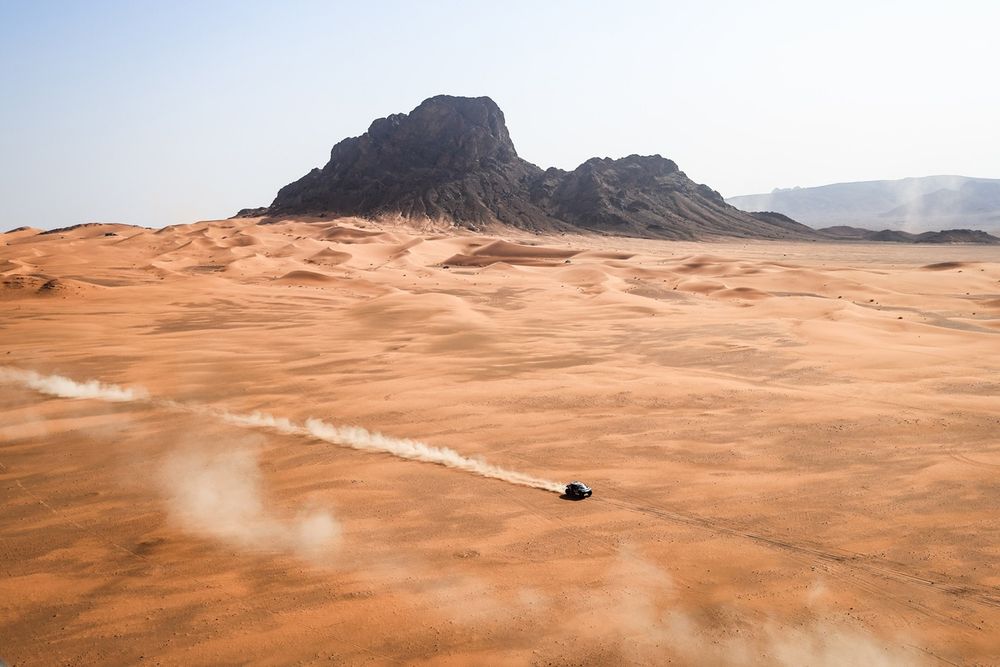
#219 The Dacia Sandriders Dacia: Sebastien Loeb, Edouard Boulanger
Photo by: Red Bull Content Pool
Still, Loeb would be open to adopting a similar time-bonus concept: “A bonus system could be a solution. I’m not the organiser, so it’s not my decision, but it could be possible.”
His Dacia team-mate Al-Attiyah wouldn’t be against it either: “If you, for example, are the one opening the route, you could get a bonus – why not? Then suddenly everyone would want to open.”
Ford driver Carlos Sainz Sr takes a more nuanced view and points out an important detail: “I’m not really in favour. What I don’t like is that as long as the bikes are in front of us, everything’s fine.
«The big yo-yo effect is coming when there are no motorbikes in front. I would say maybe give a little bit more space, but probably we don’t need it.»
Usually, the cars start after the motorcycles and can follow their tracks. Only during the four marathon stages are the routes separate, meaning the first cars must navigate entirely on their own without visible tracks.
“For the bikes, it’s an issue every day; for us, it would only apply to two or four stages,” said X-raid boss Sven Quandt. “And that raises the question: does it make sense to introduce such a system for just a few stages or not?
“It would be ideal if the routes were always separate, that would be fair. If you implement it for four stages, you have to ask: does it actually make sense? That’s really the key question – whether it would be fair and make sense mathematically in the end.
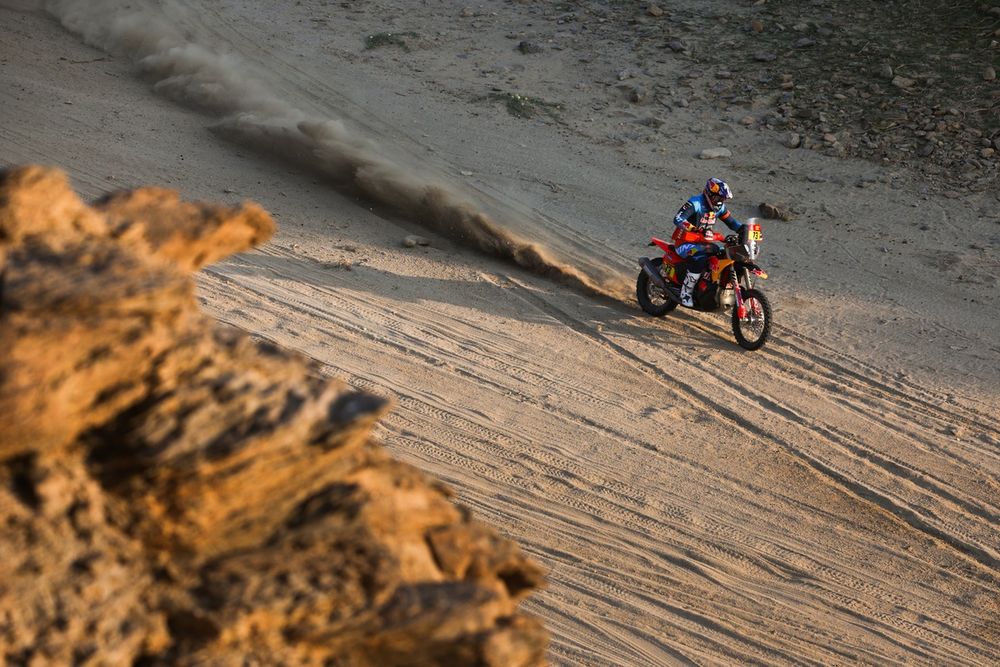
#73 Red Bull KTM Factory Racing KTM: Edgar Canet
Photo by: Red Bull Content Pool
“This topic will certainly come up again after Dakar, because for outsiders it’s very hard to understand why someone lost just because they were opening the road.
“That doesn’t really make sense, and it’s almost impossible to win two days in a row. That only happens if it’s a route where you can see all the time where you’re going. If there’s a lot of navigation involved, it becomes very difficult.”
Photos from Dakar Rally — Stage 7

2026 Dakar Rally — Stage 7, in photos

2026 Dakar Rally — Stage 7, in photos

2026 Dakar Rally — Stage 7, in photos

2026 Dakar Rally — Stage 7, in photos

2026 Dakar Rally — Stage 7, in photos

2026 Dakar Rally — Stage 7, in photos

2026 Dakar Rally — Stage 7, in photos

2026 Dakar Rally — Stage 7, in photos

2026 Dakar Rally — Stage 7, in photos

2026 Dakar Rally — Stage 7, in photos

2026 Dakar Rally — Stage 7, in photos

2026 Dakar Rally — Stage 7, in photos

2026 Dakar Rally — Stage 7, in photos

2026 Dakar Rally — Stage 7, in photos

2026 Dakar Rally — Stage 7, in photos

2026 Dakar Rally — Stage 7, in photos

2026 Dakar Rally — Stage 7, in photos

2026 Dakar Rally — Stage 7, in photos

2026 Dakar Rally — Stage 7, in photos

2026 Dakar Rally — Stage 7, in photos

2026 Dakar Rally — Stage 7, in photos

2026 Dakar Rally — Stage 7, in photos

2026 Dakar Rally — Stage 7, in photos

2026 Dakar Rally — Stage 7, in photos

2026 Dakar Rally — Stage 7, in photos

2026 Dakar Rally — Stage 7, in photos

2026 Dakar Rally — Stage 7, in photos

2026 Dakar Rally — Stage 7, in photos

2026 Dakar Rally — Stage 7, in photos

2026 Dakar Rally — Stage 7, in photos

2026 Dakar Rally — Stage 7, in photos

2026 Dakar Rally — Stage 7, in photos

2026 Dakar Rally — Stage 7, in photos

2026 Dakar Rally — Stage 7, in photos

2026 Dakar Rally — Stage 7, in photos

2026 Dakar Rally — Stage 7, in photos

2026 Dakar Rally — Stage 7, in photos

2026 Dakar Rally — Stage 7, in photos

2026 Dakar Rally — Stage 7, in photos

2026 Dakar Rally — Stage 7, in photos

2026 Dakar Rally — Stage 7, in photos

2026 Dakar Rally — Stage 7, in photos

2026 Dakar Rally — Stage 7, in photos

2026 Dakar Rally — Stage 7, in photos

2026 Dakar Rally — Stage 7, in photos

2026 Dakar Rally — Stage 7, in photos

2026 Dakar Rally — Stage 7, in photos

2026 Dakar Rally — Stage 7, in photos

2026 Dakar Rally — Stage 7, in photos

2026 Dakar Rally — Stage 7, in photos

2026 Dakar Rally — Stage 7, in photos
We want your opinion!
What would you like to see on Motorsport.com?
— The Motorsport.com Team


