
A first glimpse of a 2026 Formula 1 car in action has emerged on social media, with sneak footage of Audi’s Barcelona shakedown having been posted on YouTube and by the team.
Audi’s car, which will be known as the R26, was given a handful of laps around the Circuit de Barcelona-Catalunya – the incoming German brand is the first team known to have run its new car ahead of Barcelona’s behind-closed-doors test at the end of January.
Nico Hulkenberg and Gabriel Bortoleto were both scheduled to get behind the wheel as part of a filming day to put Audi’s first-ever F1 powertrain through its paces at Barcelona, as the ex-Sauber outfit acquaints itself with its new identity.
Although low-resolution photographs were circulated on social media purporting to be of the new car, these were little more than AI images masked by a Gaussian blur effect.
But video footage, which emerged on YouTube channel F1 A TODO GAS, shows the new R26 in action. While the footage does not show the car particularly closely, having been filmed from a vantage point behind Turn 13, there are a few key details on display.
Audi F1 Team
Photo by: Audi
The team then released teaser shots of the R26 but intentionally hid the car from focus to keep its early design secrets under wraps.
Next year’s cars are 100mm narrower, and this is a notable visual change. In the video, a slightly raised nose can be made out, as can an in-washing front wing, as the FIA’s regulations have been designed to pursue wake control around the front wing. The endplates do now feature a footplate and a flick-up to control the airflow around the front wheels.
Behind that, the most notable aspect of Audi’s new car is in its push-rod front suspension package. Sauber had gravitated to a pull-rod front suspension design in 2024, following the lead set by McLaren and Red Bull under the arrival of the previous ground-effect regulation set. The inclination of the track rod starts from the top surface of the chassis bulkhead, connecting to the lower part of the wheel upright.
It was theorised amid the previous regulations that pull-rod suspension had been more beneficial for an anti-dive approach to the car’s kinematics, but the expected softer spring rates of the new cars – now that the floors are less sensitive to any minor changes in ride height – have prompted a reversion.
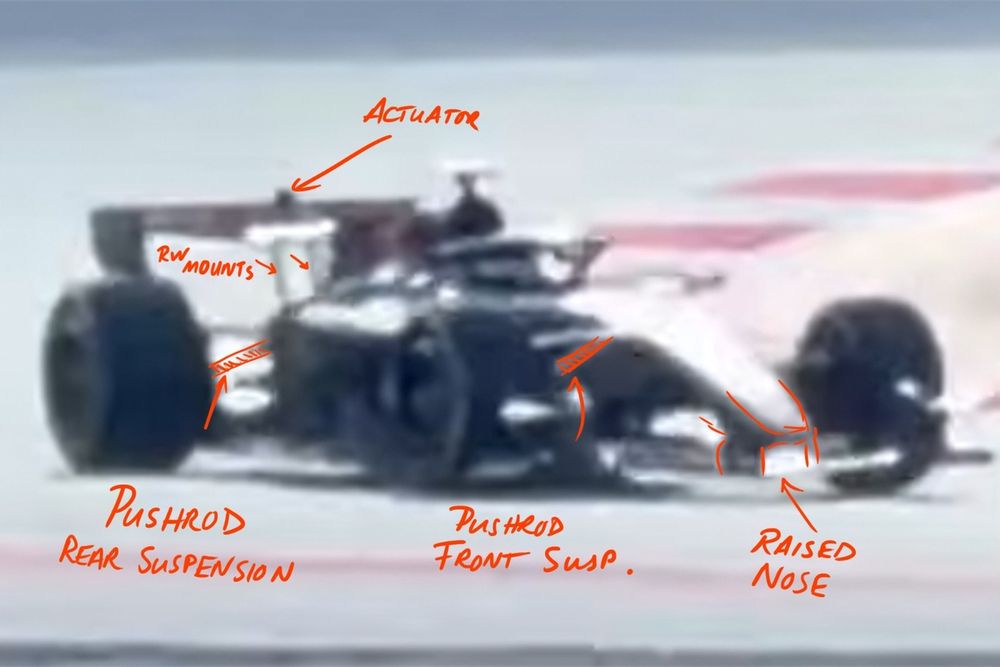
Given the graininess of the footage, it’s hard to make out the rear suspension geometry, but it also looks to be a push-rod layout too. Prior to 2022, F1 teams had largely settled on pull-rod rear suspension layouts to keep the centre of gravity low, but more teams began to adopt push-rod rear suspension over the course of the 2022-25 regulation cycle.
The sidepods are also interesting; across 2022-25, the myriad sidepod solutions seen in the early years of the formula soon converged towards Red Bull’s downwash solution, but Audi’s car appears to show an inwashing solution. This takes the flow around the sidepods to maximise the effectiveness of the Coke bottle section around the rear of the bodywork.
As long as the airflow stays attached to the car, this can pull air through the central section rather than expose the wake to the rear tyres.
Elsewhere, the engine note is not dissimilar to the previous generation of power units, although it perhaps sings a touch more heartily under acceleration. The new rear wing has a double mount attached to the underside, rather than a single swan-neck mount that was built into the DRS actuator.
We want to hear from you!
Let us know what you would like to see from us in the future.
— The Autosport.com Team


