
Hankook may investigate developing a bespoke tyre to specifically cope with the extreme Acropolis Rally Greece conditions in the future.
Tyres were once again a hot topic at the latest round of the World Rally Championship, as Greece’s extreme rough gravel inflicted a series of punctures that contributed to the outcome of the rally.
Hankook brought a revised hard compound tyre to the event after receiving criticism regarding the durability of its hard compound gravel tyre following Rally Portugal. In the short time leading up to the Acropolis Rally, Hankook was able to validate an update to the tyre by increasing the thickness of the tread to improve its durability.
WRC teams and crews confirmed that the tyre was a step forward in regard to limiting delaminations, but punctures remained a talking point. Only rally winner Sebastien Ogier and M-Sport-Ford’s Josh McErlean escaped punctures across the course of the rally, which featured some sections that were much rougher than in previous years.
Ogier, who lost a likely win in Portugal due to a puncture, confirmed the product was indeed an improvement but believes the only solution moving forward is for the tyre manufacture to develop a special tyre just for this event given its unique tyre punishing conditions.
During the event, the nine-time world champion led a successful push for stage 12 to be shortened by 4.5km due to the extreme road conditions that he felt would have been too tough for the tyres to tackle.
«The one [tyre] we used in Portugal wouldn’t have finished one stage here, so clearly there has been some step,” Ogier told Motorsport.com. “But at the same time in the extreme conditions, we have seen the real solution would be to have specific tyre for here like it used to be in the past.”
Race winner Sebastien Ogier was one of two driver to avoid punctures
Photo by: Toyota Racing
When asked if Hankook would consider developing a tyre in the future to specifically cope with the Acropolis, the brand’s WRC representative said: “I think it is worth looking at absolutely. Everything has implications of course and I don’t just mean from my side. For sure it is something that can be considered and it has been raised a few times. As it has been raised by important people, it is worth thinking about.
“It is ton of work, of course, but that is what we do. So, if that is something that we feel is important for the sport and if there is broad support for it, then it is something we can consider.
“For us, it is mixed feelings as we made such big effort to make improvements to come here and as we have heard from pretty much everyone involved, all the stakeholders have acknowledged that the tyres have made a good step forward. This is positive. But, of course, every time there is a tyre-related issue we have to do a close analysis to try to understand how much of that is just Acropolis and where are the areas we can focus next to keep it moving forward so that is a little bit of work for us to do after the event.”
Perhaps the most high-profile punctures were suffered by Hyundai’s Thierry Neuville, who was taken out of the fight for victory with Ogier by a double failure in the penultimate stage.
The 2024 world champion believes the solution is not purely down to just improving tyres, and feels the event organiser could help the situation by selecting roads with fewer extreme sections.

Thierry Neuville suffered a race-defining double puncture
Photo by: Hyundai
“There was no impact but there are so many stones around you don’t know. The Power Stage was in much worse conditions and nobody suffered a puncture. It is [a lottery],» he told Motorsport.com.
“I have had the question whether the promoter should review the roads or the tyre manufacture should improve the tyres, and I think there is a bit of both.
“With the experience we have had over the past years, I have seen a lot of rallies and the conditions are able to surprise me. So, it means it is quite tough and rough.
“I have driven with a lot of tyres over the years, and I know what is possible and what they can do. I think there is room for improvement on both sides. Maybe the roads need to be a bit smoother and the tyres can be slightly stronger. They have a hard life here.”
When asked about the Hankook tyre’s performance, M-Sport-Ford team principal Richard Millener was keen to point out that the development of the modern WRC Rally1 car has made the job of the tyre manufacturer incredibly difficult.
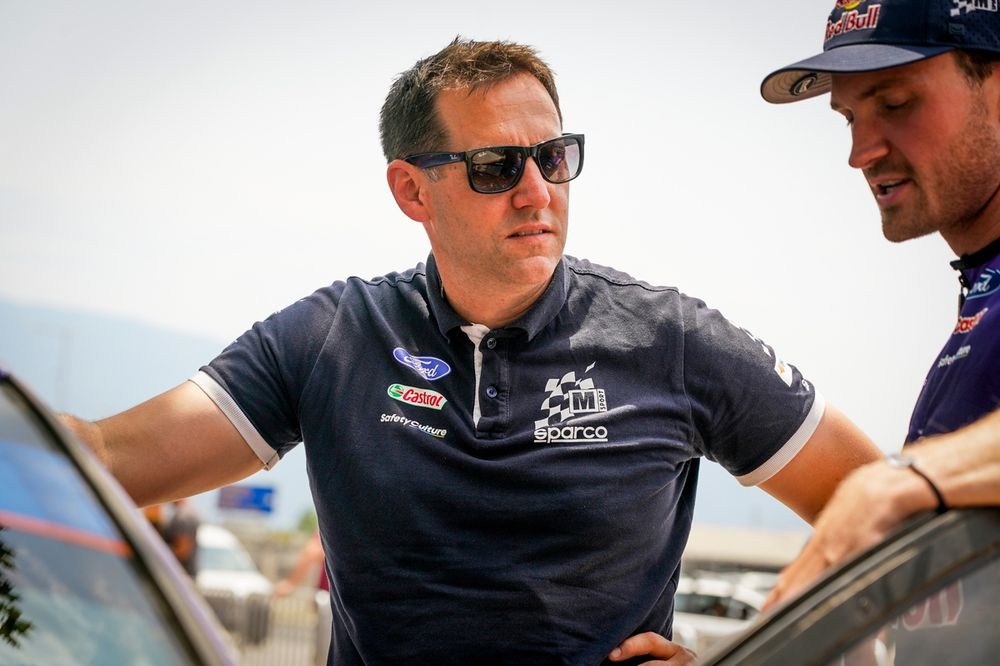
Richard Millener admits Hankook has «got a hard job»
Photo by: M-Sport
«The only way you can look at it is to go and watch a Greece rally from a couple of years ago when we had Pirelli and see how many punctures they had and see how many punctures we had here. I am almost sure it won’t be a million miles away,” he said.
“The cars are the fastest they’ve ever been. The drivers are driving harder than they’ve ever driven before, and the temperature is incredibly high. Everything’s better, and you’ll basically find that the better you make the car, the harder it is for the tyre.
“If you look in the Rally2 category and there were punctures but far less. These Rally1 cars are just incredible pieces of machinery, and I think Hankook for sure can improve a little bit more, but everybody can improve if they want to. It’s finding a happy medium.
“If you look, there were no real delamination over the weekend, which I think was a big concern. They were worried about it, and they pushed hard to get the new hard tyre here to make things better, which they did.
“I still continually say that all of their equipment, all of their information that they give the teams and media is far superior to anything we’ve ever had. We shouldn’t bash them too much. They’ve got a hard job, and it will always be the fault of the tyre if something happens.”
We want your opinion!
What would you like to see on Motorsport.com?
— The Motorsport.com Team


