
Ever since rivals discovered that Mercedes could comply with the 16:1 limit during static tests, but can achieve a higher ratio while running on track, the compression ratio has become the biggest political topic of Formula 1’s pre-season.
During the first week in Bahrain, Wolff made it clear that Mercedes had closely involved the FIA throughout the entire engine development process and kept the governing body in the loop. The FIA was aware of the background, which is why Wolff sounded confident during the season launch and stated that he had no concerns whatsoever about the legality of the new power unit.
That remains the case now – also because FIA single-seater director Nikolas Tombazis explicitly stated that there is no question of cheating – although the political reality has changed in the meantime. After Audi, Honda and Ferrari asked for clarification in a joint letter, the political pressure increased further. The result is that the matter has been put to an online vote involving all engine manufacturers, the FIA and Formula One Management.
Mercedes’ solution not in the spirit of the regulations
First of all, it raises the question of whether Wolff is surprised that it has come this far, given that Mercedes involved the FIA in the process behind the scenes.
“Philosophically, you can disagree with it because I believe regs are there to be made and you keep the FIA close to you,” Wolff said. “And that’s how it should be. But if you have four other PUs that are putting immense pressure on the FIA at a certain stage, what choice do we have than not to play?”
The Mercedes boss indicated a distinction must be made between two aspects: his pure conviction and the political reality. Philosophically, Wolff still believes Mercedes is right for two reasons.
Watch: Autosport Explains: F1 Testing Day 6
First of all, Article C5.4.3 of the technical regulations states that the compression ratio is only measured when the engine is stationary and at ambient temperature, and Mercedes developed its 2026 power unit based on this wording. On top of that comes the communication with the FIA, about which Wolff said in Bahrain: “We have had all the assurances that what we did was according to the rules.”
It must be noted, however, that the matter in reality is far more complex than that, both in terms of the regulations and Mercedes’ communication with the FIA.
“There are a lot of nuances when discussing such a matter, because there’s what the regulations intend to be, and to keep the compression ratio at 16:1 was one of the core objectives when the regulations were discussed with the PU manufacturers back in 2022, when they were finalised,” Tombazis said when asked by Autosport.
Formally, Mercedes’ trick aligns with how the regulations are written, but it appears not to be in the spirit of those regulations. Moreover, the wording of the rules also gives the competition a foothold and therefore room for debate.
The other manufacturers refer to the more general Article 1.5, which states: “Formula 1 cars must comply with these regulations in their entirety at all times during a competition.” Since the 16:1 compression ratio is explicitly written into the regulations, those manufacturers argue that all engines must comply with that figure at all times – including when running on track at higher temperatures.
This means that the exact wording was not adequate to achieve the intended objective, and that is precisely why the FIA has come forward with a proposal to tighten up the rules, which also appears to indicate how the governing body itself is likely to vote.
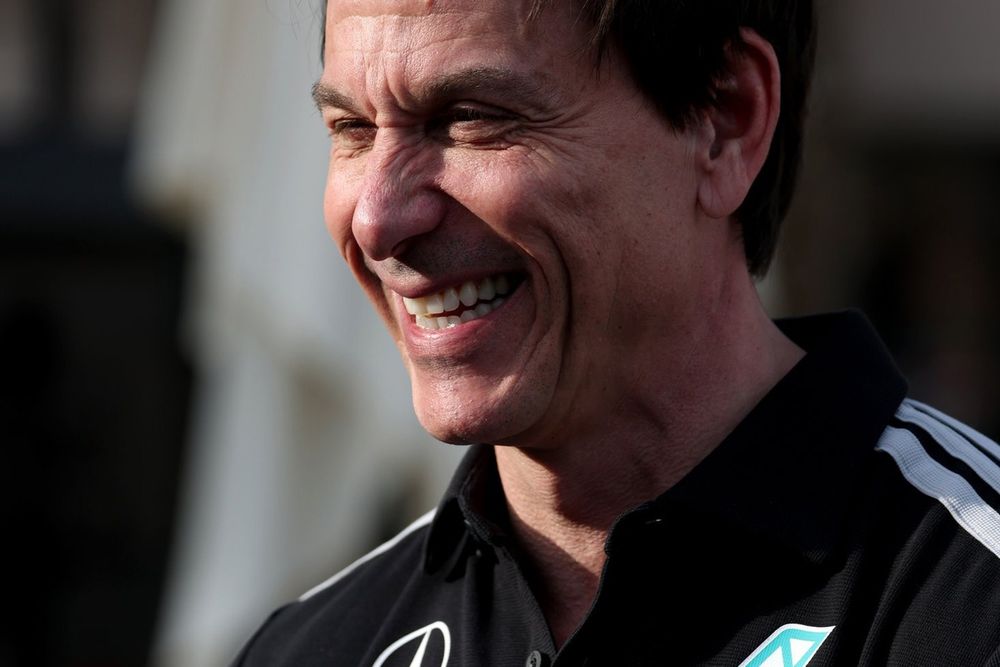
Toto Wolff, Mercedes
Photo by: Sam Bloxham / LAT Images via Getty Images
“When the rules need improving, because they don’t achieve fully the objective, we try to make amendments. We want to keep the rules focused on what the objective is, and not to be evolving gradually when interpretations have maybe stretched them,” Tombazis explained.
He called it “inevitable” that such issues would arise, given that the FIA drafts the rules with relatively modest manpower while teams have vastly greater resources dedicated to finding loopholes.
“There’s about maybe 15, 20 people dealing with regulations in the FIA,” Tombazis admitted. “But then each team has 200 or 300 people focused on performance, designing bits, trying to find downforce or performance, and the same happens for the PU manufacturers.”
Could the vote still take a different turn?
There is another aspect to this: the FIA and F1 do not want this saga to overshadow the opening races of the new era, which makes it desirable to find a political solution that most parties can live with – at least for now.
“We were pretty comfortable in even having a protest going on Friday in Melbourne, but is this what we want?” Wolff reacted to that particular threat. The Mercedes boss acknowledges that such a scenario might not be a good look for the series as a whole, and added: “We said it all along that this looks like a storm in a teacup, the whole thing. Numbers were coming up that were, you know, if these numbers would have been true, I absolutely understand why somebody would fight it. But eventually, it’s not worth the fight.”
The next question is what the outcome of the online vote will be. In order to have the compression ratio tested in two ways from 1 August onwards – one of which at 130 degrees Celsius – four of the five manufacturers must agree, plus the FIA and F1.

George Russell, Mercedes
Photo by: Guido De Bortoli / LAT Images via Getty Images
The balance of power seemed clear initially, although there have been suggestions in the paddock that it may be slightly more complex. It is important to emphasise that – if the plan goes ahead – there will be two checks. In addition to the measurement with a warm engine, the measurement with a cold engine will remain in place, and this is significant.
One suggestion is that if only a warm engine were measured, there would be opportunities to let the compression ratio drop. In that case, someone could exceed the 16:1 limit during the static test, but meet the limit at a higher temperature – somewhat the opposite of what Mercedes does. In that respect, what is currently on the table seems to be a compromise.
During his press conference appearance in Bahrain, Wolff emphasised that this is an aspect Mercedes is actually satisfied with: “I think the way it’s been done now is that it needs to be compliant to the regulations when it’s cold and when it’s hot. So it doesn’t give anybody an advantage. I think the attempt from the other guys was to have it only measured hot, so they could actually have it outside of the regulations [when] cold. So now it’s a fair game for everyone.”
How serious are the stories about Mercedes’ fuel?
Wolff became considerably more outspoken when rumours about the 2026 fuel were raised. Fuel partner Petronas is said to be in a race against time to get its fully sustainable fuels homologated in time for the Australian Grand Prix in Melbourne.
“We were told compression ratio is something where we were illegal, which is total bullshit, utter bullshit. Now the next story comes up that our fuel is illegal. I don’t know where that comes from, and it starts spinning again.
“Maybe tomorrow, we’re inventing something else that I don’t know – maybe I’ve been on the Epstein files. God knows what? So another nonsense. You know, this is a complicated topic with the process and all of this, but I can’t even comment.”

George Russell, Mercedes
Photo by: Guido De Bortoli / LAT Images via Getty Images
The FIA did not want to comment specifically on the Mercedes case, but Tombazis did acknowledge that in general the process is far more complex than before.
“I don’t think I should comment on who is fully certified or not because that is for each fuel supplier. I think it’s fair to say the new process is more complicated than what it has normally been,” Tombazis said.
“Not only do we look after the chemistry of the fuels, meaning we don’t want to have more than a certain percentage of particular chemicals and combustion properties and energy content properties. All of these are the chemical restrictions which have always been the case in F1 fuels.
“In addition to that, we have all the sustainability requirements. Each fuel has to be sustainable and it has to achieve a certain reduction of greenhouse gas emissions, that’s a core part of this formula. Each fuel contains maybe a hundred different components, different elements that go into the final blend of the fuel. In order to be sure that this is sustainable, we need to check every component.”
The FIA has delegated the certification process to an external body, the British company Zemo, which is responsible not only for analysing the final product but also for verifying the production process. Tombazis emphasised, however, that the aim remains to have everything finalised – including in Mercedes’ case – before Melbourne.
The commotion over fuel is mainly linked to the extreme complexity of the new procedure – as was the case with the introduction of the cost cap. In the engine debate, both camps have a valid point based on the wording of the regulations, which means the FIA primarily wants to remove any ambiguity for the coming years.
The compromises that have been reached so far are, from an F1 perspective, mainly intended to ensure that the season opener is not overshadowed by these political battlefields – although the question remains whether the racing itself will be good enough to take the focus for the right reasons in Melbourne.
We want to hear from you!
Let us know what you would like to see from us in the future.
— The Autosport.com Team


