
McLaren team boss Andrea Stella has urged Formula 1 to agree to several refinements to the 2026 power unit rules to improve the show and general safety.
F1’s shift to power units with a much bigger electric component, close to 50% of the total power output, has caused trepidation for many months. But as cars finally hit the track in anger at Barcelona’s shakedown and Bahrain’s official first pre-season test, it has emerged that there are three main outstanding issues that are causing the teams and drivers the biggest headaches.
The first is the race starts, which have become more complex because cars are now relying on the V6 engine to spool up the turbo at the start. In Bahrain cars were heard going on throttle for over 10 seconds to get the boost levels up to the required level. But timing the procedure slightly wrong could either cause a slow getaway or pitch the car into anti-stall, which happened to Alpine’s Franco Colapinto at the end of Friday’s running. Furthermore, cars at the back of the grid line up so late that under the current procedures they might not even get the required 10 seconds to spool up the turbo.
There are also concerns over the necessity to lift and coast at the end of a straight, which could cause dangerous closing speeds with a car going flat out behind. Another worry is the fact that cars are so energy starved that they run out of battery power so early that in the absence of a DRS-like system there is less scope to gain overspeed on the car in front.
What is making the matter extra critical is that Barcelona and Bahrain aren’t even considered anywhere near the worst circuits for energy harvesting, so incidents could escalate further at more power-hungry circuits.
Lewis Hamilton, Ferrari, Isack Hadjar, Red Bull Racing
Photo by: Sam Bagnall / Sutton Images via Getty Images
McLaren team boss Andrea Stella is urging the F1 community to come together to implement key fixes in time for Melbourne’s season opener to improve the situation, both on safety ground and to improve the on-track spectacle. Next Wednesday’s F1 Commission meeting with the 11 teams, the FIA and commercial rightsholder FOM is an opportunity to agree to any 11th-hour changes ahead of the Australian curtain raiser on 8 March.
«We are not talking about how fast you are in qualifying. We are not talking about what is your race pace. We are talking about safety on the grid,» Stella said about the complicated race start procedures. «There are some topics which are simply bigger than the competitive interest. And for me, having safety on the grid, which can be achieved with simple adjustment, is just a no-brainer.»
One solution could be to make tweaks to the timing of the start procedure to give drivers a bigger window to spool up turbocharges to the right RPM level on the grid.
«We need to make sure that the race start procedure allows all cars to have the power unit ready to go, because the grid is not the place in which you want to have cars slow in taking off the grid,» Stella explained. «This is a bigger interest than any competitive interest. So, I think all teams and the FIA should play the game of responsibility when it comes to what is needed.»
Overtaking has now been complicated by the removal of DRS and the introduction of active aerodynamics, which allow all cars to flatten their front and rear wings on designated straights, limiting to ability to create a speed difference.
«In the past, DRS created such an advantage from an aerodynamic drag point of view for the following car,» Stella set out. «This year, when you follow somebody, you have the same drag and the same power, so it becomes quite difficult to overtake. Our drivers have been racing with other drivers during these three days of testing in Bahrain and they found it extremely difficult to overtake.»
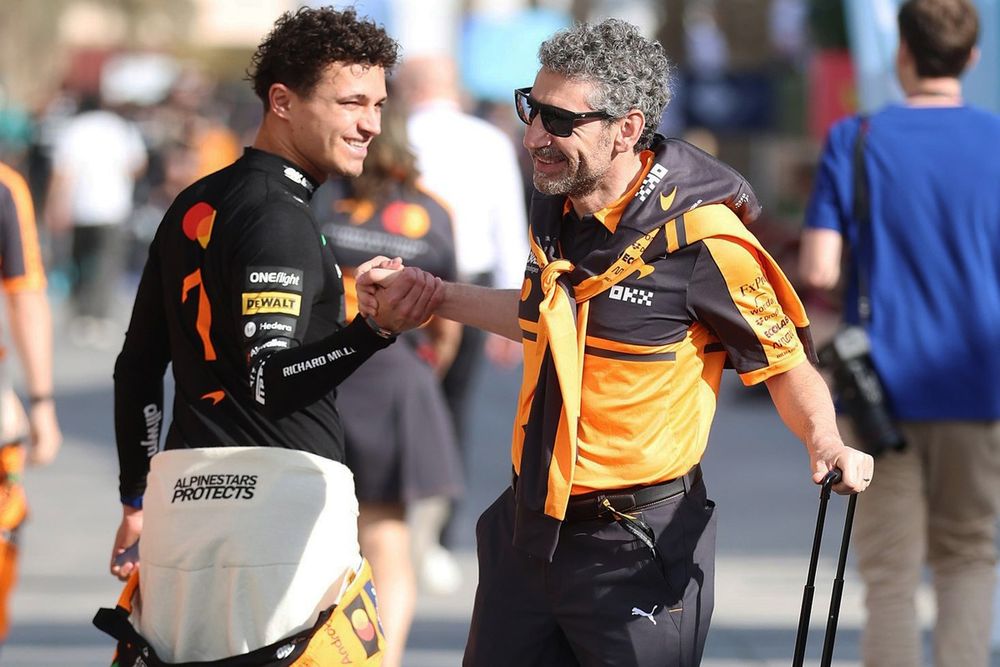
Lando Norris, McLaren, Andrea Stella, McLaren
Photo by: Steven Tee / LAT Images via Getty Images
The boost mode that has been implemented is felt not to make enough of a difference to offset the lack of DRS, because cars generally don’t have enough energy left to expend anyway. One possible solution here would be to reduce the maximum allowed electric power output in the race, currently 350kW, which has the double benefit of cars running out of energy much later on the straight as well as ensuring that the new boost mode actually works as advertised to create a bigger offset.
«The fact that you have an additional amount of energy when you follow and you are within the one second is difficult to exploit, because this extra energy may mean that there is just a little bit more deployment at the end of the straight, if anything,» Stella said.
«So I think, again, as an F1 community, we should look at what can be done to make sure that we have a sensible feasibility when it comes to overtaking. Otherwise, we lose one of the fundamental elements of the nature of racing, which is giving drivers the possibility to overtake.
Stella’s final point on limiting the need for lifting and coasting is also a big safety concern given the extreme closing speeds with the current cars when the car in front runs out of battery, which could see a repeat of incidents like Mark Webber’s huge airborne shunt in Valencia in 2010.
«This may not be an ideal situation when you follow closely and this can give a race situation like we have seen before a few times with Webber in Valencia, [Riccardo] Patrese in Portugal and there are a few more that definitely we don’t want to see anymore in Formula 1,» Stella cautioned.
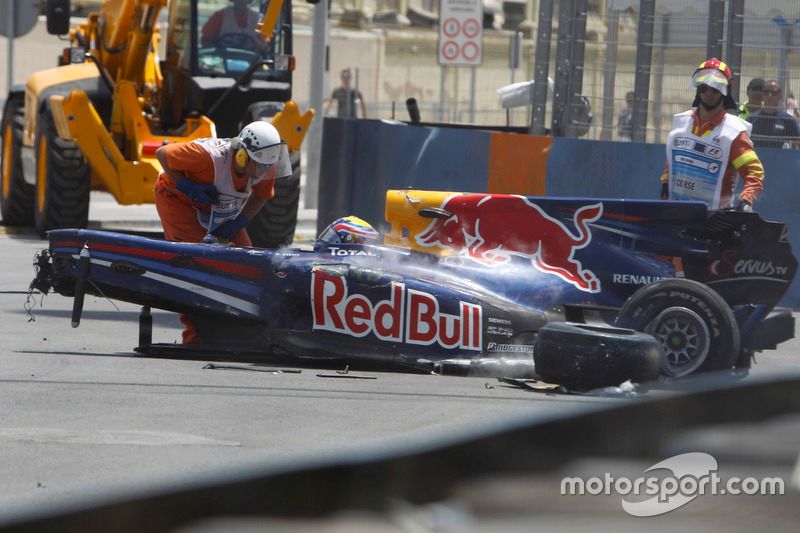
Marshals remove the wrecked car of Mark Webber, Red Bull Racing
Photo by: Motorsport Images
One way to at least reduce the need for lift-and-coast techniques is to make tweaks to the regulations around ‘superclipping’ which is the phenomenon when cars start harvesting energy while still going full throttle. Currently cars are allowed to ‘superclip’ up to 250kW, but increasing the amount to the full 350kW capacity of the electric motor would give cars more energy to play with without resorting to more dangerous techniques.
«[It’s about] three simple things — starts, overtaking and finding measures to avoid the lift and cost,» Stella concluded. «I think these simple technical solutions exist and they will be discussed in the next F1 Commission.
«I think it’s imperative because it’s possible and it’s simple. So, we should not complicate what is simple and we should not postpone what is possible immediately.»
It remains to be seen if teams will find common ground in the F1 Commission meeting, although the FIA could push through changes if necessary on safety grounds.
We want to hear from you!
Let us know what you would like to see from us in the future.
— The Autosport.com Team


