
In the 10th season for the venerable Lexus RC F GT3, Vasser Sullivan Racing is proving that experience, internal evolution, and relentless focus on execution can still set the benchmark in IMSA WeatherTech SportsCar Championship competition.
Rather than seeking outside fixes, the team has doubled down on a core philosophy: Built, not bought. Through strategic internal promotions and a retooled pit stop program, Vasser Sullivan has reclaimed its championship contention form, proving that small operational tweaks can deliver game-changing results on track.
Returning to the Core Philosophy
Travis Morgan (left), James ‘Sulli’ Sullivan (middle), Bozi Tatarevic (right)
Photo by: Vasser Sullivan Racing
The shift in momentum wasn’t born out of radical redesigns, but rather a return to fundamental principles following early-season setbacks.
«After letting another Sebring win slip away the way we did this season, it was clear it was time to get back to that,» James ‘Sulli’ Sullivan, Co-Owner of Vasser Sullivan Racing, told Motorsport.com.
«We had a saying that guided us in our most recent championship run: ‘We don’t need extraordinary things, we need the ordinary things, done extraordinarily well.’
“We’re devoting our energy to executing on this every day. And we’re seeing the fruits.»
That renewed commitment paid massive dividends recently at Canadian Tire Motorsport Park (CTMP), where race-winning strategy met flawless pit lane execution.
Retooling the Pit Lane
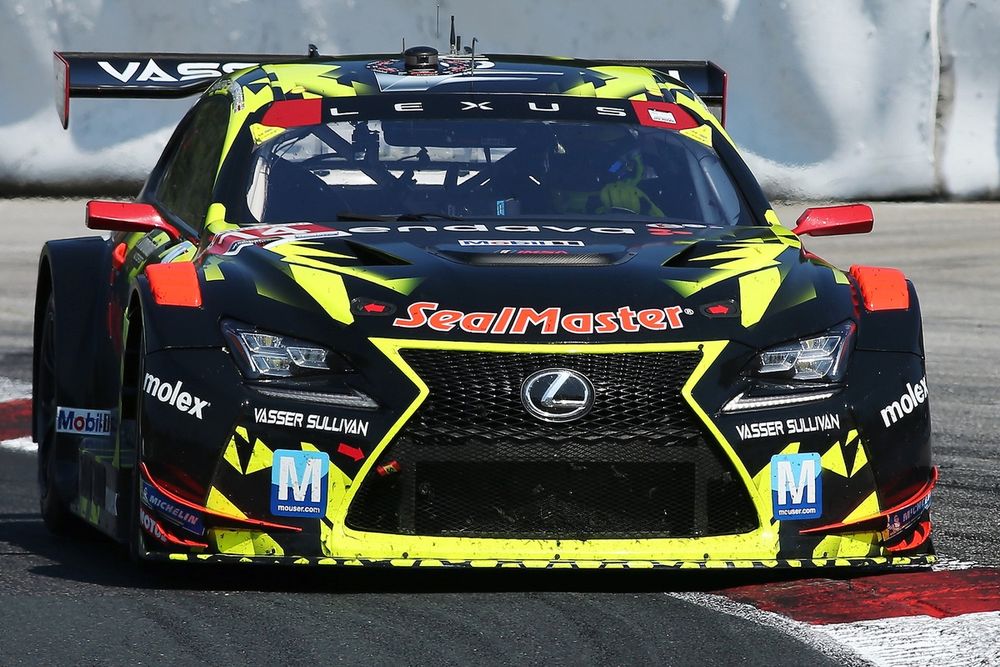
#14 Vasser Sullivan Racing Lexus RC F GT3: Jack Hawksworth, Ben Barnicoat
Photo by: Art Fleischmann
The defining moment of the CTMP race came during a crucial first pit cycle. Strategy and engineering leaders Geoff Fickling and Dwight Brown on the #14 Lexus RC F GT3 called for an aggressive short-fill stop. The pit crew delivered, beating every opponent off pit lane and reshaping the course of their weekend.
That lightning-fast stop was months in the making and a direct result of an overhauled pit stop program focused.
The structural overhaul relies heavily on rigorous review and dedicated trackside oversight. Under the leadership of Team Manager Greg Cates, the team now conducts deep-dive video analysis of every pit stop from prior events, pairing the footage with open roundtable discussions that bring drivers and ‘cold side’ support personnel directly into the dialogue. Complemented by Travis Morgan’s promotion to Crew Chief – a shift that places him on the outside of the pit box to observe stops in real time and offer immediate feedback – Vasser Sullivan has built a tight feedback loop centered on continuous refinement.
At the same time, equal weight is given to grassroots innovation, with crew members actively encouraged to voice ideas regardless of their position. That collaborative environment paid direct dividends at Canadian Tire Motorsport Park, where tire technician Richard Boyles suggested a modified tire placement position and front changer Saul Perez Hernandez recommended a subtle timing tweak. Both crew-driven adjustments yielded immediate speed gains on pit lane, proving that race-winning execution relies just as much on crew initiative as it does on strategy from the pit wall.
The team’s pit lane prowess relies on a deep well of firsthand experience. Cates was an accomplished tire changer in CART and IMSA who won multiple pit stop contests – and even pitted for team co-owner Jimmy Vasser in the 2003 Indianapolis 500. Meanwhile, Boyles brings a NASCAR tire-changing background, and Perez Hernandez offers experience from IMSA GTP and NASCAR.
Empowering Leadership From Within
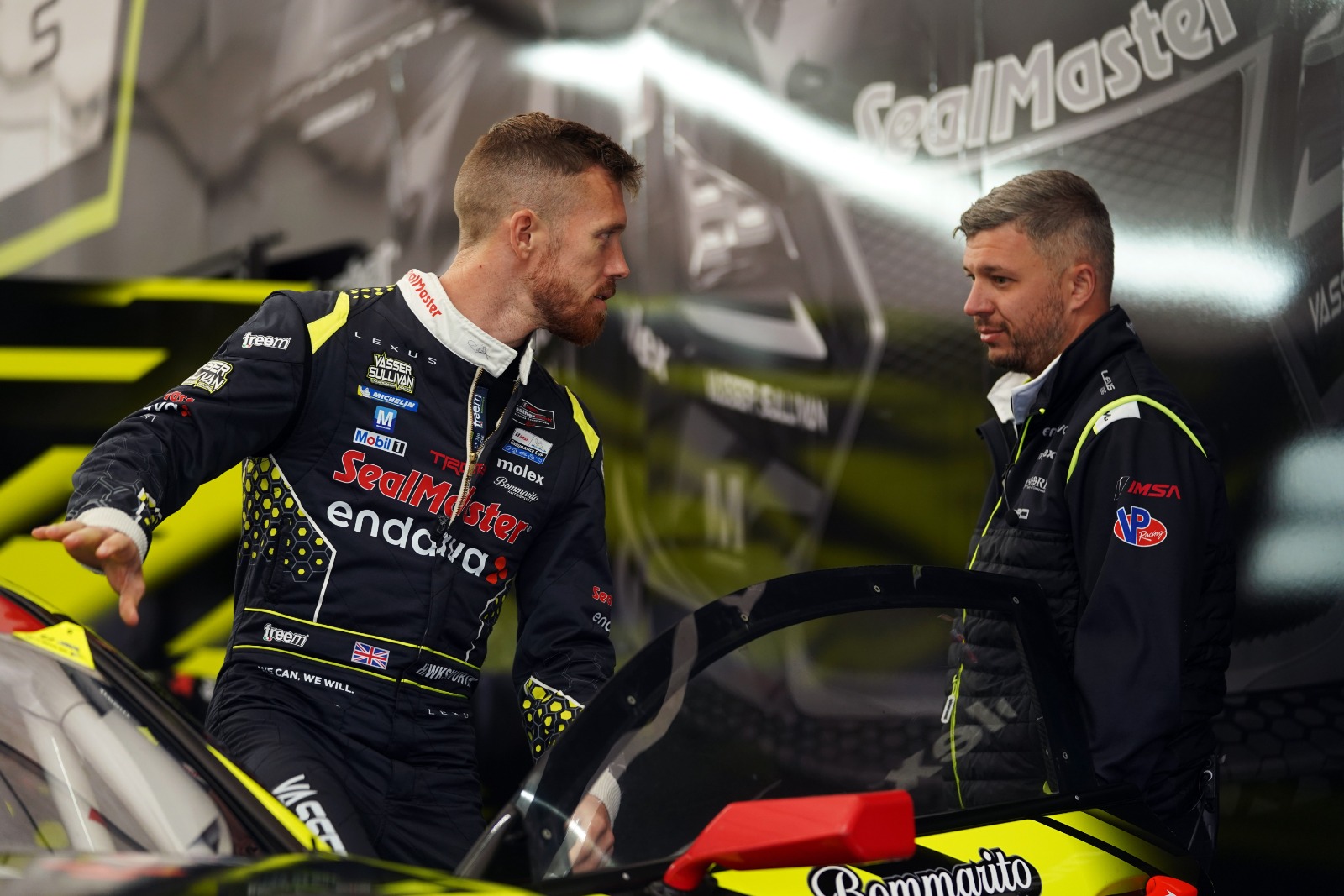
Jack Hawksworth (left), co-driver of the #14 Vasser Sullivan Racing Lexus, with Travis Morgan (right)
Photo by: Vasser Sullivan Racing
Central to Vasser Sullivan’s current trajectory are key personnel moves made for the 2026 season that emphasize growth from within the organization.
Having joined Vasser Sullivan in 2021 and served as Car Chief on the #14 machine starting in 2022, Morgan stepped into the Crew Chief role over both cars this season.
«The biggest thing I’ve learned and something that I’m still learning is that I need to step back and delegate,» Morgan told Motorsport.com. «In my earlier roles as a car chief and a mechanic, I was always one of the first to jump in and try to solve issues by being hands-on. But in my new role as crew chief, I have learned to empower the mechanics to tackle the issues themselves and guide them using my experience and observations.»
Stepping into Morgan’s former role as Car Chief on the #14 entry is Adam Berberich. After working across NHRA, Ferrari Challenge, SRO, LMP2, and LMP3, Berberich rejoined Vasser Sullivan full-time in 2025 before earning his promotion to Car Chief for 2026.
«Over-communication and documentation have been key elements of my transition to car chief in order to ensure transparency while working to keep everyone on the same page,» Berberich told Motorsport.com.
«The unexpected thing I’ve had to learn to do is to manage multiple timelines at once: be in the present enough to guide what’s going on in the moment to do our immediate jobs, think ahead to minimize obstacles in the future, and address things that have happened in the past.»
Championship Pedigree Across the Board

#12 Vasser Sullivan Racing Lexus RC F GT3: Aaron Telitz, Benjamin Pedersen
Photo by: Brandon Badraoui / Lumen via Getty Images
Beyond the pit lane refinements, Vasser Sullivan’s operational surge is anchored by elite engineering talent across both garages. Leading the charge on the #14 Lexus RC F GT3 is Race Engineer Fickling, whose winning rapport with driver Jack Hawksworth dates back to their dominant 2012 Star Mazda championship campaign. Fickling brings a battle-tested resume to the stand, having engineered Indy Lights title runs for Gabby Chaves in 2014 and Ed Jones in 2016 before serving as a race engineer and strategist in the IndyCar Series.
On the #12 side, Race Engineer Matt Beckman adds an equally formidable technical pedigree. Beckman’s extensive background spans championship-winning CART squads at Newman/Haas Racing, a 2005 stint assisting co-owner Jimmy Vasser at PKV Racing, and a storied tenure at Joe Gibbs Racing – where he engineered Denny Hamlin to a Daytona 500 victory and managed the organization’s entire simulation and engineering group. Together, Fickling and Beckman provide the high-level tactical depth required to consistently turn split-second pit road execution into race-winning results.
A Fitting Farewell
As the decade-old Lexus RC F GT3 prepares for its final laps in top-flight competition, Vasser Sullivan Racing isn’t relying on past glory. By trusting internal talent, empowering team members at every level, and perfecting the «ordinary things,» the squad has reignited a winning formula capable of fighting for victories right down to the final checkered flag.
We want your opinion!
What would you like to see on Motorsport.com?
— The Motorsport.com Team


