
During the post-season test at the Yas Marina Circuit, Formula 1 teams are given nine hours to gather data about Pirelli’s 2026 tyres.
The test is carried out using mule cars – ground-effect machinery modified to mimic 2026’s lower downforce levels. All teams run with reduced wing levels (comparable to Monza) and altered ride heights to shed downforce.
An interesting aspect is that the FIA has permitted teams to run certain prototypes in Tuesday’s test. One area where this applies is the front wing.
DRS will disappear from F1 in 2026 and be replaced by active aerodynamics, meaning drivers will open both the front and rear wings on every straight. As a result, the front wing will become an active component too, unlike in previous seasons.
Mercedes prototype draws attention in the pitlane
A first glimpse of the future can be seen in Abu Dhabi on the Mercedes mule car driven by Andrea Kimi Antonelli. The car is equipped with a Straight Line Mode system, allowing the front wing to generate less drag on the straights.
Mercedes’ system at this test is far from refined, with an actuation system on the upper wing elements connected to the nose cone with via large tubing. This allows the wing to switch to a low-downforce configuration on the straights, mirroring what will be used in a more sophisticated way in 2026.
Mercedes front wing detail
Photo by: Zak Mauger / LAT Images via Getty Images
Ferrari has also gained experience with a similar concept. The Scuderia tested its own prototype during a private mule-car test and has also brought its own system to Abu Dhabi.
Besides offering teams early insight into active aerodynamics, these prototypes also provide valuable data to Pirelli. The Italian tyre supplier can compare mule cars running without active front aerodynamics to those equipped with the system.
“Talking about the front Straight Line Mode, the FIA gave the opportunity to the teams to develop a system that was replicating this on the front wing. In that case, obviously, they don’t have to comply with the speed limit restriction,” Pirelli’s Mario Isola explained. Mule cars have a speed limit of about 300km/h on straights to avoid overloading the tyres.
“It’s also useful for us because you can compare a car that is running without the system with a car that is running with the system. When we did the first test with Ferrari with the system, it was really useful to understand and to compare this test with all the other tests, in terms of load and what we achieved, to understand and to make the other tests more representative.”
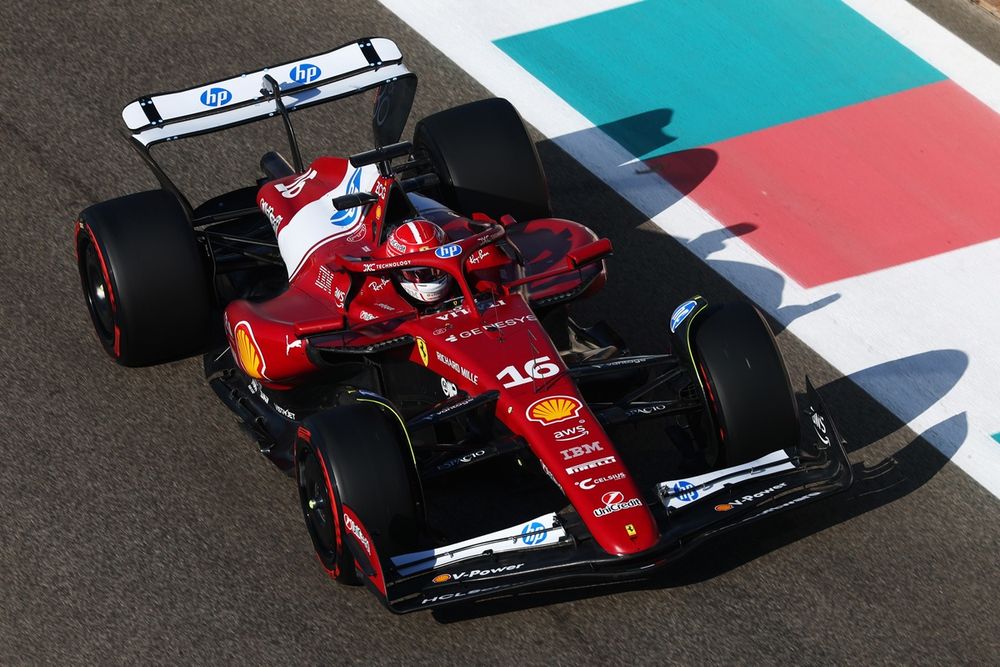
Charles Leclerc, Ferrari
Photo by: Clive Rose / Formula 1 via Getty Images
Teams also experimenting with new wheel rims
In addition to the active front wing, some teams are running wheel rims that form a hybrid solution between current rims and those planned for 2026.
“In some cases, teams ask for testing rims similar to the ones they are going to use next year, when they obviously have more freedom in designing the rim. And they have been authorized by the FIA to do a certain number of runs with the new rims.”
However, the results of those tests are not entirely representative for next year, as tyre heat management also heavily depends on the brakes – and the brakes will be different in 2026. All teams in Abu Dhabi are still running the current-spec brakes.
We want to hear from you!
Let us know what you would like to see from us in the future.
— The Autosport.com Team


