
One of the biggest learning curves of the new Formula 1 regulations has been the increase and required management of electrical energy, an area where drivers could be exposed in the early rounds if they fail to optimise deployment.
Almost all the drivers have detailed the challenge of where and when to deploy F1’s new boost mode over both single laps and race runs, with Andrea Kimi Antonelli comparing it to a form of “speed chess”, as opportunities and risks are present each time a driver selects or abstains from a dose of power from the 350kW available from the MGU-K.
Alongside the fundamental task of the Barcelona shakedown which allowed teams to run-in their new cars and get to work on fixing reliability niggles, the track action allowed drivers the first real-world experience of the new power units, modes and tools available to them, having only been able to try infant versions of it in simulators – which was met with a mixed reaction at best.
Overall the drivers’ feedback from the on-track reality has been to embrace the challenge, even if it meant an entirely new way to drive a car, and the teams and drivers who adjust the fastest are likely to be the biggest successes in the early rounds.
Haas F1 team principal Ayao Komatsu underlined this point by highlighting the risk and reward that’ll be on show in qualifying, particularly in the early rounds, when perfecting the power deployment across the lap will be a huge performance decider.
“In our case, Barcelona is one of the very challenging ones,” Komatsu said, referring to getting the power management right. “It’s because of the track layout and how the last corner is. Then I think Bahrain is going to be slightly easier. Having said that, there’s a lot of work we need to do still to really get us better prepared.
Esteban Ocon, Haas F1 Team
Photo by: Haas F1 Team
“I think the first several races, at least, I think you will see some issues. Not issues as in the car breaking down, issues in terms of not optimising your deployment for qualifying, for example, or during the race.
“That’s something that really needs to be focused on in terms of going through those procedures, make sure you get the consistency. But then again, even if you get to the stage where you’re very confident in Bahrain with the consistency, then you go to Melbourne with a completely different condition.
“That’s going to be a huge challenge. So I think it’s going to be a steep, steep learning curve for most of us.”
The Haas team boss said it is a task both driver and race engineer will be able to jointly focus on, with those on the pitwall able to feed the vital live data to their chargers, plus the all-important preparation work undertaken before each race weekend.
“I don’t think you can separate drivers and engineers in this instance. This is the good and bad challenges of this new regulation,” Komatsu added.
“The drivers and engineers, they really need to work together in a much more integrated way than before, in terms of energy management, how much can we load the drivers up, how much can we expect from a driver on every single lap during the race. So really, it’s a team effort, including drivers. It’s really both together.
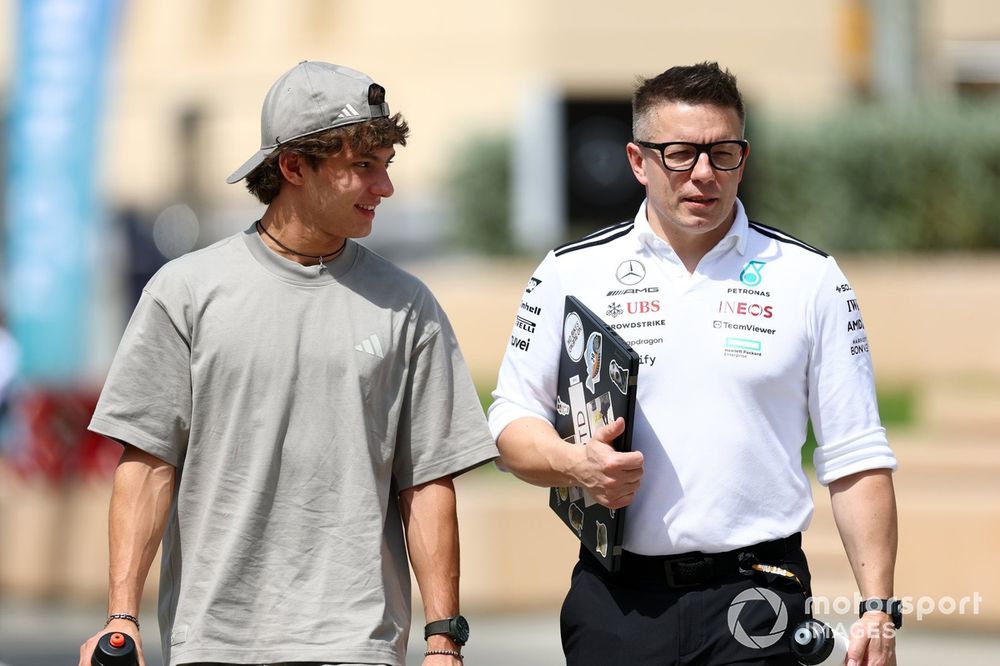
Andrea Kimi Antonelli, Mercedes, Peter Bonnington, Race Engineer Mercedes
Photo by: Zak Mauger / Motorsport Images
“I think fans will see straight away in the sense that if somebody is not deploying correctly, let’s say opening the qualifying lap on a pitstraight going into Turn 1, if somebody is not going very quick, you realise straight away that they didn’t do it correctly. So I think it will be very visible, especially early on.
“I haven’t had time to really digest everybody else’s GPS data. Maybe Mercedes hasn’t got that inconsistency. But harvesting is very condition-dependent, driver-dependent, and then the software needs to work very well to have robustness. So there is more vulnerability [at the] start of the season.”
It is this vulnerability that could be the cause of some big lap time gaps in qualifying over the early rounds, even before considerations around outright car and power unit performance across the grid is factored in.
“I think if something goes wrong, I think it will be pretty obvious because we’re not talking about tenths,” Komatsu explained. “You can lose half a second, six, seven tenths very, very easily. That’s the scary bit.”
We want to hear from you!
Let us know what you would like to see from us in the future.
— The Autosport.com Team


