
May 1994 brought an existential crisis in Formula 1. Roland Ratzenberger and Ayrton Senna were killed in separate accidents during the San Marino weekend, inviting the harshest possible scrutiny – and then, shortly after their emotional funerals, Karl Wendlinger suffered major head injuries when his Sauber hit a barrier sideways during practice for the Monaco Grand Prix.
Naturally there was urgent pressure for something to be done – or at least seen to be done. For years a widespread assumption had persisted that Formula 1 was safe enough, and it had been over a decade since the last fatality at a grand prix.
Beyond immediate reactionary changes, such as installing temporary chicanes at some circuits to reduce corning speeds, the FIA began a programme of rigorous scientific research to identify and implement safety improvements to improve standards at the tracks, and on the cars themselves.
«Until then, a failure to apply basic science and scientific methods systematically had been a fundamental problem,» the then president, Max Mosley, later wrote in his autobiography, a tome in which ‘safety’ sits in uncomfortable proximity to ‘S&M’ in the index.
«It was all piecemeal and unsystematic. Some unwise and unscientific things were done in the name of safety before reason took over. Armco barriers, particularly in the wrong place as in Francois Cevert’s fatal accident in 1973, are a classic example.»
Larger run-off areas, better cockpit head protection and more stringent crash testing of the chassis were among the visible results, but the events of Imola and Monaco and 1994 also gave impetus to a culture of continuous improvement. There was an acceptance that F1 had become complacent and could not afford to do so again.
Mika Hakkinen’s accident in Adelaide in 1995 brought fresh safety questions
Photo by: Getty Images
Another prompt to improve safety came in the form of Mika Hakkinen’s accident in Adelaide in 1995, when a puncture sent his McLaren into a concrete wall at Brewery Bend. The arrival of the medical car within 20 seconds, enabling doctors Jerome Cockings and Steve Lewis to perform an emergency tracheotomy which saved Hakkinen’s life, evinced the effectiveness of the welfare improvements made thus far.
But was this a sign that more could be done? Hakkinen fractured his skull, so violently did his head hit the steering wheel.
This brought head and neck injuries back to the top of the agenda and among the solutions evaluated was an onboard airbag with a volume of approximately 60 litres. Initial tests showed a slight reduction in the risk of head trauma in the event of a frontal impact.
But the potential effectiveness of this system remained very limited. Due to the drivers’ highly reclined position in the cockpit, the main impact would have been absorbed at the chin. Above all, engineers feared accidental activation: the extreme g-forces experienced during the race, and the shock impacts of aggressively driving over the kerbs, could be enough to trigger the system even without a collision.
Mercedes engineer Hubert Gramling, later recruited to the FIA Institute, oversaw the airbag testing but was then introduced to a potential alternative by F1’s medical delegate, Professor Sid Watkins. In the early 1980s the American IMSA stalwart Jim Downing had lost a friend in a testing accident at Mid-Ohio and begun exploring the principle of a head brace with his brother-in-law, Dr Robert Hubbard.

Heinz-Harald Frentzen (Sauber-Ford) in 1995
Photo by: Motorsport Images
By 1985 Hubbard had filed the first patent for what would become the HANS (Head And Neck Safety) device, a year later Downing raced one for the first time, and in 1991 it had gone into production. But initial uptake was slow; Downing reported that fellow racers sneered as if taking additional safety precautions was an affront to their masculinity.
Still, the principle of mitigating head deceleration was sound, and testing proved the HANS could be more effective than an airbag.
«When we were looking for a solution to neck injuries, the idea of an airbag was seriously considered,» said Red Bull team principal Laurent Mekies, then the FIA’s safety director, in 2017. «Then HANS arrived. And it proved so effective in precisely addressing the problem we were trying to solve that it rendered the airbag unnecessary in the context of motorsport.»
The concept was taken up and refined in the late 1990s with the support of the FIA, Mercedes and McLaren. It was officially presented to the Formula 1 paddock during 2000 San Marino Grand Prix weekend.
The FIA released a statement the time which read «A Formula 3000 monocoque, with a cockpit corresponding to the dimensions of 1998 F1 cars, was used for crash tests. During these tests, the HANS device demonstrated remarkable effectiveness. Extreme accelerated head movements are significantly reduced, thus decreasing dangerous loads on the neck. The HANS device also prevents the driver’s head from striking the steering wheel or the edge of the cockpit.»
The drivers say no – at first
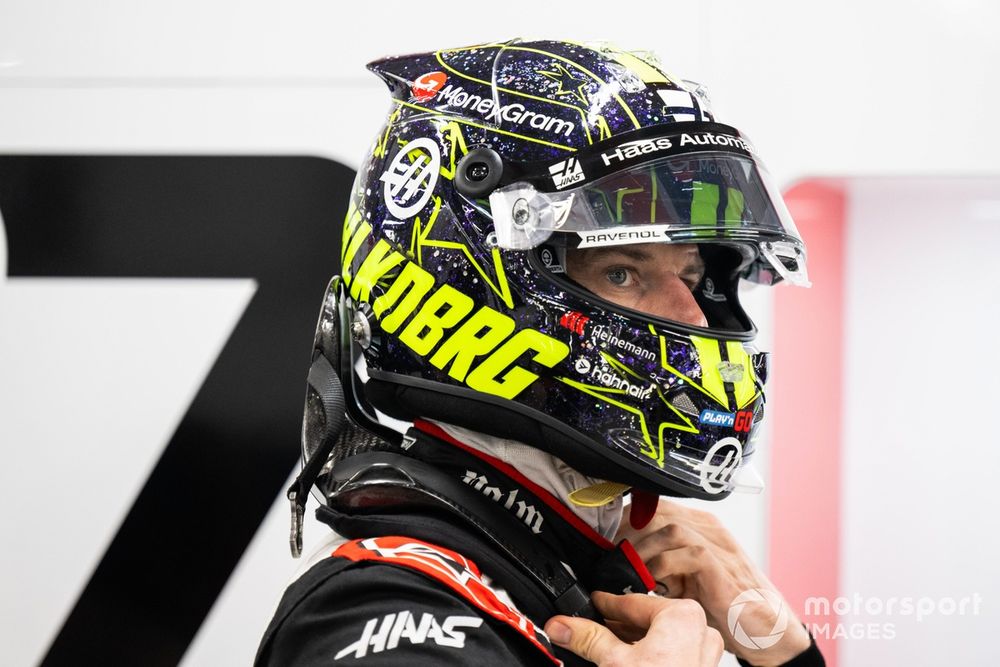
Nico Hülkenberg models the modern HANS device
Photo by: Simon Galloway / Motorsport Images
Despite these results, there was initial resistance to adopting the device in F1, along similar lines to the derision encountered by Downing during the late 1980s. Felipe Massa was the first F1 driver to demonstrate the HANS device during a GP weekend, at Monza in 2002, and the first to make a point of wearing it thereafter.
But others came to the table only grudgingly after it was made mandatory in 2003. Jacques Villeneuve, in particular, was highly critical after an accident during free practice for the Japanese Grand Prix, at the Spoon corner.
«I’m very glad I wasn’t wearing it for my accident,» he told Autosport at the time. «My body would have moved, but the HANS device would have stayed in place. It would have dug into my neck. There are situations where it can become dangerous.»
While these fears proved unfounded in practice, other drivers complained of discomfort. Rubens Barrichello, for example, retired on the sixth lap of the opening Grand Prix of the 2003 season after a spin. «I wasn’t focused on the track, the HANS device was pressing on my collarbone and causing me a lot of pain,» he said at the time.
The FIA made a special exception for Barrichello to compete in the following race without HANS, but thereafter he was directed to get with the programme. In any case advancements in materials and ergonomics quickly overcame these reservations, and wearing one became a habit, making it an essential safety device that has never been questioned by subsequent generations.
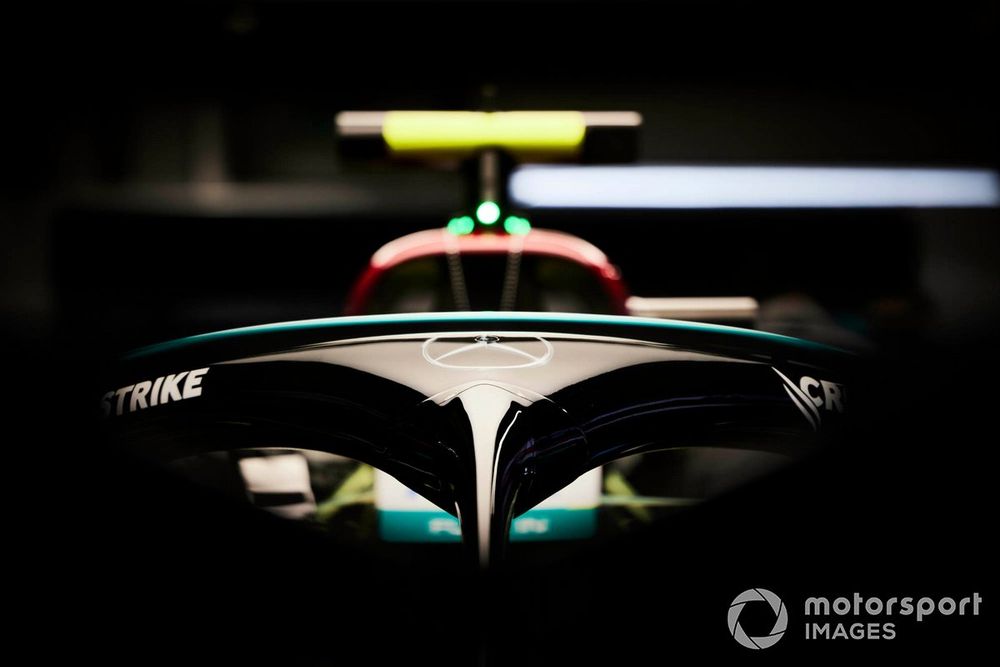
The halo was a radical safety improvement which also met with resistance
Photo by: Steve Etherington / Motorsport Images
Today, in the era of the halo – introduced in F1 in 2018 – and equivalent devices like the aeroscreen in IndyCar, it is simply unthinkable to imagine a top-level driver behind the wheel without HANS. Meanwhile, it was in motorcycle racing that the airbag finally found its place: integrated into racing suits, it is now a safety standard in MotoGP and other two-wheel championships, where its effectiveness is no longer in doubt.
We want to hear from you!
Let us know what you would like to see from us in the future.
— The Autosport.com Team


