
When race stewards and officials need to send a message to Formula 1 drivers on track, they can call on teams to relay the information over the radio, or can throw up a flag around the track to instantly alert drivers. Marshals at F1 circuits can wave nine different flags, and some are used a lot more than others.
At the start of every race, the green flag is waved to indicate that the track is clear and racing can start, while the chequered flag is waved to signal the end of a grand prix. F1 fans the world over will be familiar with these two flags, while the other seven flags available to marshals can be waved at any point during a race to either warn drivers about something or give racers a specific instruction.
Over the course of a race, marshals may wave yellow flags to signal an obstruction on track ahead and, depending on how they are waved, call on racers to reduce their speed. The blue flag means a fast-moving car is approaching and mandates that slow-moving cars move off the racing line to let the leaders passed, or in a race for a car to move over to be lapped by the leaders.
The red flag is another common site in F1 and it brings the on-track action to an end, commonly due to weather issues or other incidents on track that make it unsafe to continue. When it is waved in a race, drivers are required to reduce their speed and proceed to the pits where they then line up at the pit exit while they await further instructions.
While slightly less common, the black and white flag indicates to a driver that they have been reported for unsportsmanlike behaviour. These days, this flag is most commonly waved to alert racers to track limits violations.
But there are three flags that are seen even less frequently in F1, including one that hasn’t been waved in more than a year.
Photo by: Dom Romney / Motorsport Images
Yellow and red flag
The yellow and red striped flag is one of the tools that stewards and marshals have to alert F1 drivers to the conditions on track. The flag is waved by marshals to warn racers about a change in grip levels up ahead and is often waved if oil or water spill onto the surface of the race track.
Unlike the yellow flag, which is waved for danger on track, this striped counterpart doesn’t require a response from drivers – like slowing down. Also, unlike most other flags at the marshals’ disposal, the yellow and red striped flag isn’t waved and is, instead, held stationary for drivers to see.
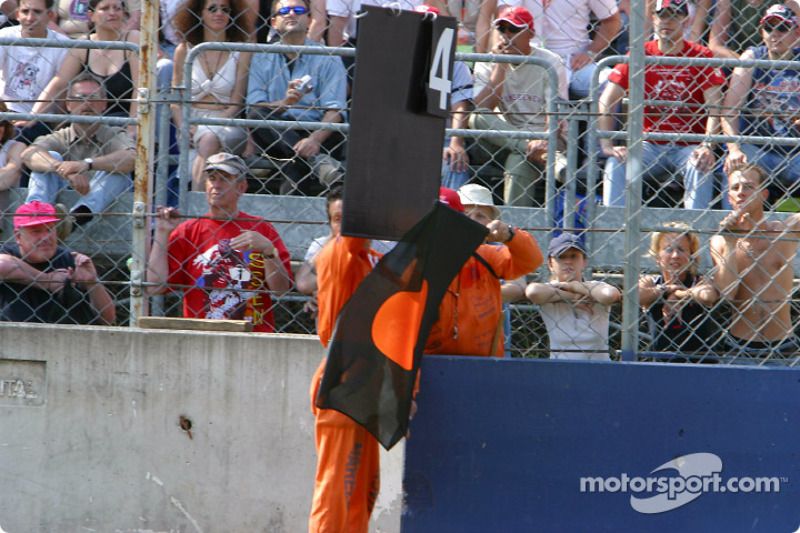
Photo by: Cello Sports Media
Black and orange flag
This flag features a black background with an orange circle in the centre, and for this reason it is sometimes referred to as the “meatball” flag.
This flag is waved for any driver facing a mechanical issue on their car that could impact the other drivers on track. It’s waved for things like a leak or a loose part – think a clipped front wing end plate – and requires drivers to head into the pits for repairs.
The flag was notorious through the 2022 season, with it waving an several consecutive grand prix – even prompting the FIA to admit that it was trigger-happy with its use over the season. Now, it’s use has dwindled to the point that teams are even calling for stewards to use it in races more regularly. How the tables have turned.
Ignoring a black and orange flag will result in disqualification from the grand prix.
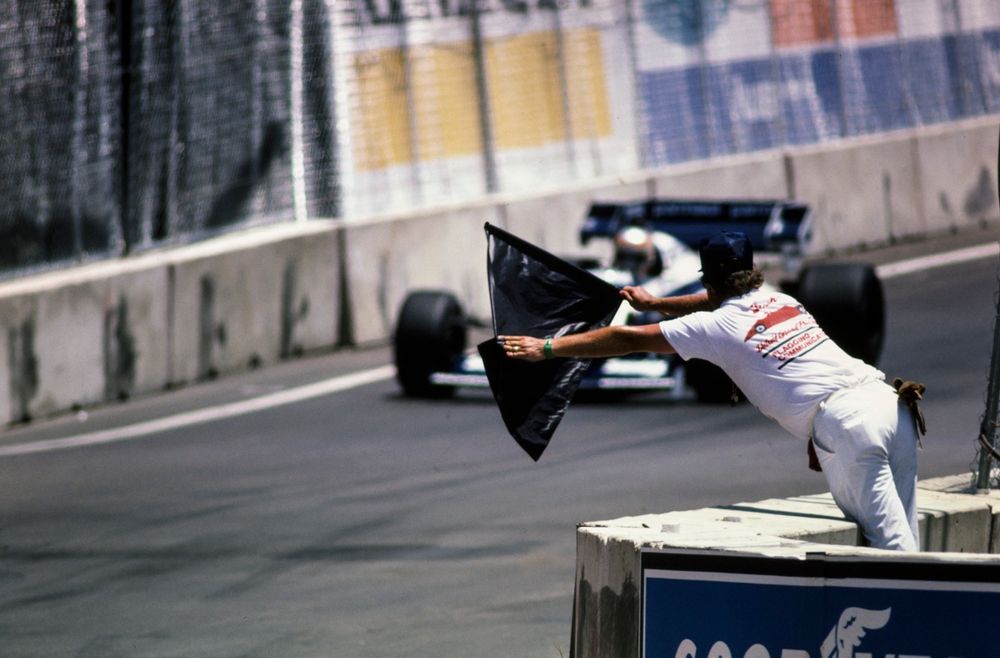
Marshall holding out a black Flag, Dallas GP
Photo by: David Hutson / Motorsport Images
Black flag
The least waved flag in F1 is the black flag, which has only been used 16 times over the course of the championship’s 75-year history.
This flag is used to instantly disqualify a driver from a grand prix, and once the black flag is waved at them the racer on the receiving end must return to their pit garage at once. The decision to show this flag rests solely with the stewards presiding over a grand prix and its use in an F1 weekend is rare.
The black flag was last waved at Nico Hulkenberg at the 2024 Sao Paulo Grand Prix for receiving outside assistance. Prior to that, it was last used at the 2007 Canadian Grand Prix when Giancarlo Fisichella and Felipe Massa both left the pitlane while the red light was showing.
We want to hear from you!
Let us know what you would like to see from us in the future.
— The Autosport.com Team


