
You hear it before you see it – that’s the motto of the Ford Raptor T1+ at the 2026 Dakar Rally. At the heart of the prototype lies a 5.0-litre Coyote Darkhorse V8 engine, featuring 32 valves, a bore of 93 millimetres and a stroke of 92.7 millimetres.
By using a naturally aspirated engine, Ford is following a different powertrain philosophy than its immediate competitors. The Dacia Sandrider uses a 3.0‑litre V6 engine with two turbochargers, and the Toyota Hilux is powered by a 3.4‑litre V6 – also with two turbos.
“When we started designing the car, the regulations were still a bit different,” explains Joan Navarro, chief engineer at M‑Sport, in an interview with Motorsport.com. “This engine was originally intended to be used with an air restrictor.
“At Dakar 2024, you were still allowed to compete with a naturally aspirated engine and restrictor. But after Dakar, when we began testing, the rules changed, meaning we had to install a torque sensor like everyone else.
“So, we had to adapt, since the car was already finished and we didn’t have time to completely redesign it. But once we saw the results and did plenty of testing, we found that it actually worked really well.”
With the torque sensor, the FIA monitors a prescribed torque curve, effectively equalising performance across vehicles. The top speed of all T1+ cars is limited to 170 km/h. Under these parameters, the naturally aspirated V8 engine has no disadvantage compared to the smaller turbo engines.
Among the frontrunners, Ford was the only manufacturer to receive minor time penalties for slightly exceeding the torque curve. The only other case involved the private Toyota of Michal Goczal.
“On the engine side, there are no major differences,” says Navarro, who sees the field as well balanced. “Throttle response is good. I’m not sure whether it’s better or worse than the others, but it’s good.
“Another important factor is simplicity and reliability. That’s the biggest advantage of this engine. You don’t have an intercooler or a turbo, you generate less heat, cockpit temperatures are lower, and everything is simpler.
“The engine is more robust than a turbo, and since reliability is extremely important at Dakar, that was the main reason.”
Cooling and aerodynamics, which ensure optimal airflow through the vehicle, are among the most complex aspects of a Dakar car.
Ford M-Sport team area
Photo by: Red Bull Content Pool
Cooling as a major challenge
Computational Fluid Dynamics (CFD) analysis is the main method used to study and optimise cooling for different operating conditions, including varying ambient temperatures.
“Aerodynamic drag and downforce aren’t that important to us because we only reach 170 km/h at most, and most of the time we’re going 60 or 80,” Navarro explains. “So we’re actually slow. At 60 km/h, drag is hardly an issue because it’s so low.
“But cooling at those speeds is also very limited, so you need a very good system since not much air flows through the car. The ducts and everything have to be positioned extremely well. That’s where we put in a lot of work.”
The dunes, in particular, are a huge challenge. Speeds are low, yet to move forward in the sand, the driver must stay on the throttle. The engine runs at high revs, and temperatures increase dramatically.
“Average speed in the dunes is about 40 km/h, and you’re at full throttle, because you need much more power in the sand. That’s the worst‑case scenario: low speed and high energy demand. The system design really has to be spot‑on.”
No fuel issue despite five litres of displacement
The maximum fuel capacity for a T1+ car per stage is 500 litres. You might expect a five‑litre V8 without forced induction to be excessively thirsty, but that’s not the case with the Ford Raptor.
“If you ran this engine without any limits, I think it could produce around 500 horsepower,” Navarro says. But that theoretical figure isn’t possible in practice due to the mandated torque curve.
“When you restrict the power, the fuel consumption isn’t that high. It would be if it ran unrestricted. But at this low output – around 268 or 270 kilowatts, so under 400 horsepower – the engine isn’t working hard and doesn’t use much fuel.”
The reduced power output is also why the Raptor has only one exhaust instead of one per cylinder bank.
“If the engine were unrestricted, it would make sense to have two. But with the current power limit, we run a single one because it’s simpler,” Navarro explains.
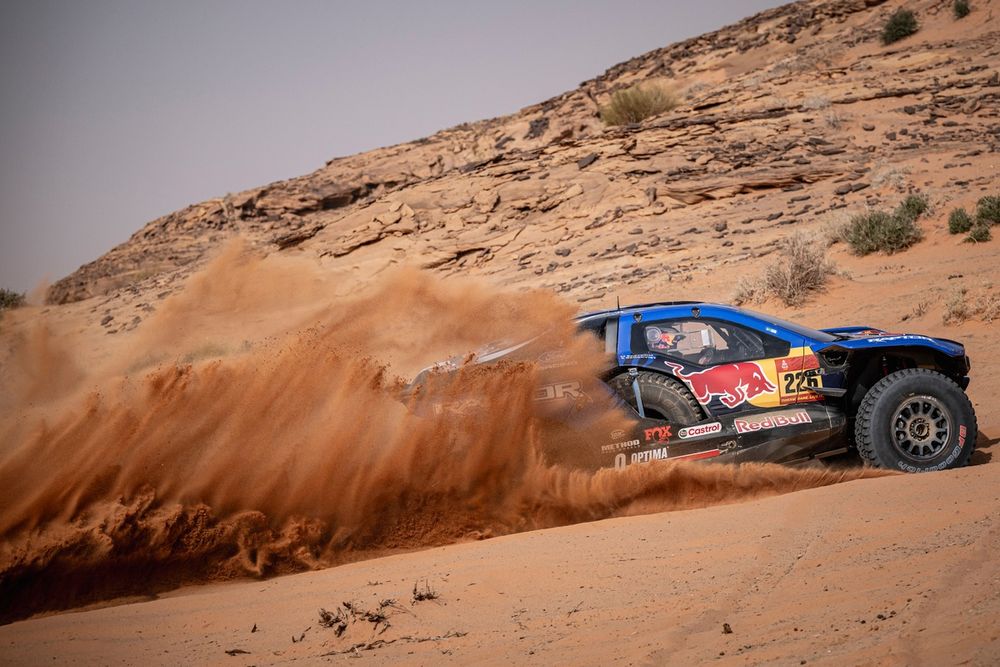
#226 Ford M-Sport Ford: Mattias Ekstrom, Emil Bergkvist
Photo by: Red Bull Content Pool
Why Ford uses Fox dampers
M‑Sport develops and builds the entire Raptor at Dovenby Hall in the UK. The engine and gearbox are also assembled in those historic facilities. But Ford is taking its own path not only in engine choice but also in suspension.
While most competitors use Reiger dampers, Ford employs products from Fox. At first, the team wasn’t sure whether this would be the right decision, but early testing proved it to be a smart move.
“We know Fox has a really strong background in the US,” Navarro notes, pointing to Baja racing in California. “We just weren’t sure how they’d perform in terms of traction, cornering, and rally‑style handling, since Dakar is a mix of both.
“So, we did a lot of testing and eventually saw that they worked really well. We chose them because they actually perform better. We’re really happy with them. There are two shocks per wheel, each operating completely independently.”
Focus on weight reduction
Ford enters the Dakar Rally for the second time as a factory team in 2026. On its debut in 2025, the team won two stages, and Mattias Ekstrom finished third overall. Over the past twelve months, the car has undergone numerous detail changes beneath the bodywork.
On one hand, the team worked closely with Fox on suspension development; on the other, it focused on reducing overall weight to get closer to the 2,010‑kilogram minimum requirement.
“When you build a first‑generation car – and this applies to every manufacturer – it always ends up heavier than anticipated. You lose performance because of that,” Navarro explains, pointing out the simple reason: “You play it safe.
“In the first year, you don’t want to risk breaking down; you just want to accumulate mileage. So you over‑engineer everything, make parts a bit stronger than necessary. Our number one priority this time was weight reduction.
“Priority two was fixing all the problems we had – component failures, damage, maintenance issues, and so on. And the third topic was engine performance.
“As I said, we built the original car for a restrictor setup, so we had to adapt and spend many hours making sure the electronics worked properly. Those were the three main areas.
“Then there were a lot of smaller ones, like the dampers – we made a big step forward with the suspension and several other small improvements.”
The updated version of the Raptor is internally called “Evo.” A total of seven cars from Ford are competing in Saudi Arabia, three more than in the first year.
We want your opinion!
What would you like to see on Motorsport.com?
— The Motorsport.com Team


