
Major regulation changes usually lead to bigger gaps in Formula 1. Both the teams and the FIA expect a bigger field spread than last year, although the governing body has introduced several measures to prevent a repeat of 2014.
At the start of the hybrid era, Mercedes arrived with a superior power unit, after which dominance was effectively locked in for years. With the 2026 reset, such a scenario is theoretically possible again, but the FIA has learned from the past and added some safety nets to the regulations.
On the power unit side, the most important one is the ADUO system. It means that after every six races (1–6, 7–12 and 13–18), the FIA will look at the power output of the internal combustion engines. Manufacturers that are between 2% and 4% down on the strongest ICE will be allowed one extra upgrade, while manufacturers more than 4% behind will be permitted two additional upgrades.
A key difference this time is that not only the power unit regulations are being overhauled, but the technical reset applies across the board: new engine rules, a new set of chassis regulation including active aerodynamics, and a switch to fully sustainable fuels.
It raises the question of what will be the most important performance differentiator in 2026.
“I would expect the engine to be the main factor initially, the ICE. We obviously have newcomers and new ICE regulations, so we expect some initial differentiation,” FIA single-seater director Nikolas Tombazis told select media, including Autosport.
Nikolas Tombazis, Head of Single Seater Technical Matters, FIA
Photo by: Mark Sutton
“But we also believe that we’ve also put in place procedures to, let’s say, enable people to gradually catch up. So we believe that it’s a temporary matter in terms of performance differentiations.
“Then we have completely new aerodynamic regulations as well. Naturally, there will be some solutions that are better and some that are worse. There will be some initial convergence, I guess, over the first six months or one year.”
That was also evident under the 2022 regulations, which began with roughly three different sidepod concepts: downwash (Red Bull), inwash (Ferrari) and zeropod (Mercedes). Over time, most teams moved towards Red Bull’s downwash solution, albeit often with their own variation.
Bigger gaps in 2026?
As for the gaps between teams, the FIA’s prediction is twofold: initially the differences will be bigger than last year, but if the regulations work as intended, the long-term picture should actually be even closer than in the previous cycle.
“For 2026, I would not expect to have the grid quite as close as what we had last year. But I would expect that the converged grid [later on] is closer than what it was in 2025,” Tombazis said.
Regarding the differences between teams in 2026, Pirelli has indicated that the initial downforce simulations from teams varied significantly. In December, however, Pirelli received a new round of simulations, including the predicted loads for the end of 2026. The Italian tyre supplier has said that those predictions were much closer together than before, so does that give Tombazis some more confidence?
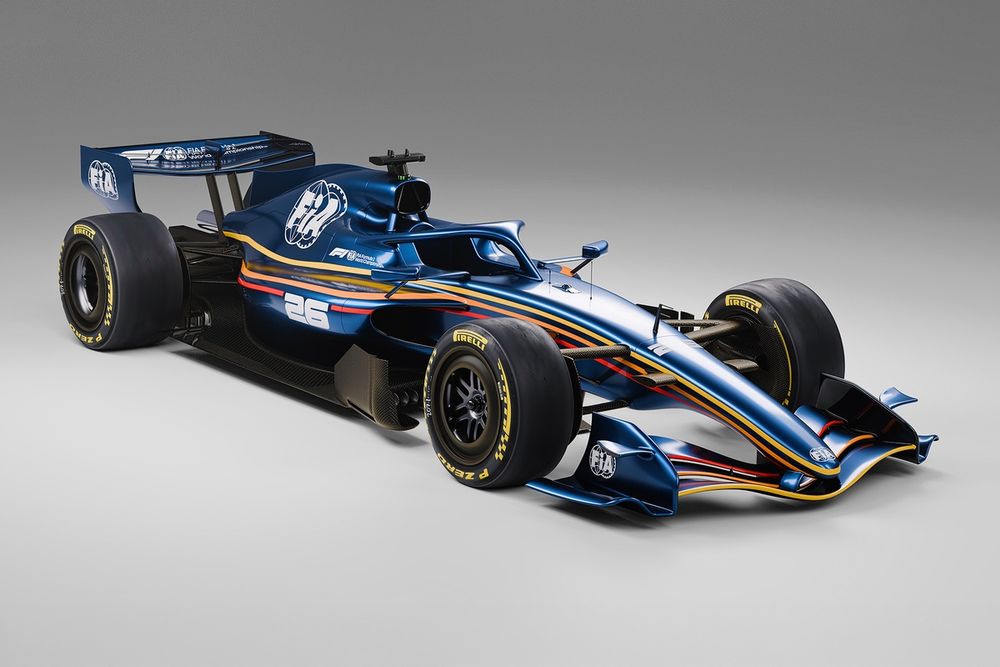
2026 FIA F1 car render
Photo by: FIA
“Reasonably, but we cannot be sure because we don’t have detailed data from the teams, so we don’t know how much downforce they have now or how much horsepower they have,” he pointed out. “Initially, I think there may be some variation, but we are pretty sure that the converged performance should lead to a smaller [more compact] grid.”
Finally, Tombazis wanted to add one key point: the entertainment value for fans is not necessarily determined by the gap between the fastest and slowest team.
“I think what determines the closeness of the grid is not necessarily the gap between the first and the last,” he insisted. “If one or two teams are in a bit of trouble initially, I don’t think that determines how exciting a championship is.
“Usually that’s determined by how close, let’s say, the people in the top half are, so the teams battling for points and wins. And I think there we will have a reasonably close field.”
We want to hear from you!
Let us know what you would like to see from us in the future.
— The Autosport.com Team


