
For Red Bull, the 2026 season marks a new chapter in the team’s history: for the first time since taking over Jaguar in 2005, it will compete with its own power unit in Formula 1.
In the longer term, this should bring advantages – especially with the integration of the power unit into the chassis – although questions remain over how competitive the new package can be in the short term.
Ford Performance director Mark Rushbrook has previously confirmed that internal targets are being met and the project is on track, but the key question is where other PU manufacturers have set the bar.
Rushbrook agrees with Toto Wolff’s assessment that Red Bull-Ford, as a newcomer, has “Mount Everest to climb”, but knows there is no time for a slow start in 2026.
Max Verstappen’s manager Raymond Vermeulen has said that this year will be key for the Dutchman’s long-term future, which makes sense given that the driver market appears fairly open for 2027.
When Verstappen’s future was a topic of discussion last year, Rushbrook already made clear that Ford’s F1 commitment is not dependent on just one individual – and therefore not on Verstappen either – although he does stress that he is pleased the four-time world champion is still there.
Red Bull Ford Powertrains
Photo by: Red Bull Content Pool
“He is a generational talent. To have a champion in the car with a Red Bull Ford power unit is important, right? We believe in the team, we believe in the power unit, and we believe in the people that are designing the car. But at the end of the day, it comes down to the driver to get every single ounce out of it. And we believe Max is a champion,” Rushbrook told Autosport in an exclusive interview.
However, he reiterated that Ford’s commitment is not tied to one driver: “Max is an important part, but it’s not to the point where we would say, oh, if he’s gone from the team, we are too. No, we know that we have confidence in the team and that we’ll get other drivers in the future.”
What’s needed to keep Verstappen on board?
The ideal scenario is, logically, to keep Verstappen on board beyond 2026, but Ford knows what that requires.
“As racers, we want to win no matter what. So it is important to go out on track and to perform.” Rushbrook said. “We know that 2026 is going to be a challenging year for everybody in the paddock because of the new rules. And regardless of the driver, it’s important for the team to deliver.”
When pointed out that, given the driver market and Verstappen’s situation, Red Bull-Ford may have little time to ease into things, Rushbrook continued: “My comments are independent of Max. We want to be on the track with the intention of winning.”
That may sound ambitious for a newcomer and differs from, for example, Audi. The brand with the four rings has stated it wants to fight for the world championship in 2030, meaning the timelines of Red Bull-Ford and Audi appear to differ significantly.
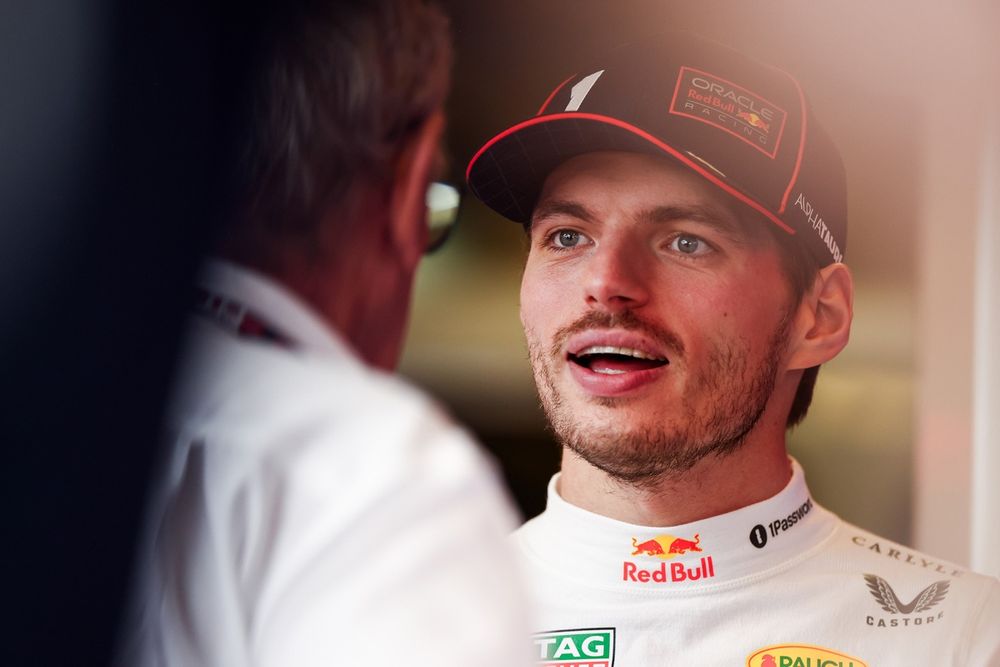
Max Verstappen, Red Bull Racing
Photo by: Peter Fox / Getty Images
“Yes, but I think they’re in a different position. In terms of where the team is, where the car is et cetera. In terms of what the team can deliver with a car, you have seen that with Red Bull already. And that is partly going to carry over to 2026,” Rushbrook said.
“We’ll see where we really are in Barcelona and Bahrain. We want to be at the front of the grid no matter what. We know it’s a massive challenge with the all-new power unit, but that’s our intention. And if we’re not, we’re still committed to doing everything that we can to get to where we want to be.”
A diverse group
The Powertrains project has a notably diverse composition. In addition to Red Bull and Ford employees, the team also includes people recruited from Honda (Red Bull’s previous engine partner) as well as hires from Mercedes High Performance Powertrains.
This means knowledge from various places can be brought together, although the key challenge is to ensure that all these people with different backgrounds work together as effectively as possible.
“And that is always a challenge,” Rushbrook responded. “It was about developing a culture, whereas the existing engine manufacturers already got their culture. In this case, it was at least within the Milton Keynes campus, with a culture there. So there’s people coming in and adapting to that. But growing from zero Powertrains employees to over 500 now, you’ve got to get all of them to accept that culture and to embrace it.”
According to Rushbrook, Verstappen has shown a strong interest in the project. It’s important not just for technical feedback – for example the driveability of the new engine – but also as a signal to everyone working at the factory.
“He has been through the facility several times. It’s great, I think, for the team to see his interest and to have him there. Showing that he cares matters, for sure. It’s great that he’s got that interest and at the same time he can get confidence in what the team is delivering for 2026.”
We want to hear from you!
Let us know what you would like to see from us in the future.
— The Autosport.com Team


