
As far as motorsport challenges go, it doesn’t get much bigger than setting up a new Formula 1 team from scratch. Building one across continents to debut under the extremely complex 2026 regulations? If not mission impossible, then at least mission improbable.
The fact that Cadillac has pulled it off, meeting every deadline along the way and achieving respectability from the start, is a huge credit to the hundreds of men and women who were recruited in a short amount of time — many hired without even knowing if the team would be allowed onto the F1 grid at all.
But the squad is also adamant that without much-needed assistance from parent company General Motors, it wouldn’t have made it at all.
It’s well documented that Cadillac’s road to F1 was a rocky one, starting life as a Michael Andretti-led effort before morphing into a de facto works effort from GM, which holds a minority stake in the team largely owned by TWG Global.
It’s not just GM’s marketing prowess or the prospect of a works power unit, which is currently under development while it takes Ferrari customer engines, that has made a difference to Cadillac’s F1 fortunes, though.
By operating alongside a wide portfolio of the automotive giant’s many racing programmes, including NASCAR, IndyCar and sportscars, Cadillac has also been able to tap into GM’s crucial resources to fast-track the development of its first-ever F1 car and the people that operate it.
«Obviously, GM’s an equity shareholder in the team, so we have vested interest in it,» Eric Warren, General Motors’ Vice President of Global Motorsports Competition, told Autosport. «Not only is the chassis named Cadillac, and it’s called Cadillac Formula 1 team, but we see it as our team. From the very beginning when we decided to get involved, we wanted to really be an integral part of it as much as we could.
«We’ve had a lot to learn, and obviously you have to be humble when you’re coming into any race series. But we didn’t just want to be a sticker. We wanted to really be a part of it. I was there from the very start when it was three people and then as it kind of grew, we looked at it and said: ‘Okay, what capabilities and gaps could we fill to get going?’
«For the first year or two, let’s be honest, we were proving to the FIA and to F1 management that this wasn’t just a small start-up team or an IndyCar team coming over here. This was truly GM being partners with TWG. So a lot of the early technical work was really building up the foundation that the team needed to be able to operate at the pace of Formula 1.»
Simon Pagenaud is one of the Cadillac F1 Team simulator drivers
Photo by: Antoan Phu / Cadillac F1 Team
In Cadillac F1’s case, before it entered a race against 10 established rivals, it had to embark on a race against time to even get there, with the finish line the start of the 2026 season in Australia at the start of March.
That truncated timeline between setting up the foundation of the team, being officially accepted and making its 2026 debut meant that it could not have possibly had all the right hardware and infrastructure in place at its current base in Silverstone, nor would that have been an efficient way of allocating its resources.
That’s where the GM Charlotte Technical Centre comes in. Opened in 2022 and located on the campus of NASCAR stalwart Hendrick Motorsports in Concorde, North Carolina, the two-floor, 130,000-square-foot facility houses an array of driver-in-the-loop simulators and various performance programmes, including aerodynamic and suspension testing tools.
«Across all of our series, each is a little bit different as far as our level of involvement,» Warren explained. «I compare it to a hospital. If you have a problem or an illness, then you go to hospital and you say: ‘Hey, I’m having this issue.’ You have an expertise that can look at it, come with a solution and a treatment plan, and then you go off. Technically, we are an engineering service provider with a vested interest in it being successful.
«We have four full dynamic simulators that we run full time. We’re getting ready to go to seven across different series, and we’re having to even lease time and build new facilities. On the DIL [driver-in-the-loop] side, nothing really had to be built a bespoke cockpit for, because we actually used the IndyCar cockpit for a long time. Obviously, you’re trying to create the right pedals, steering columns, steering wheels; the driver interface has to be correct. But all the other systems, most of the software and all the models, of course, are a combination of what they contract us for and things they’re doing. And then we’re working with Ferrari on the engine model.»
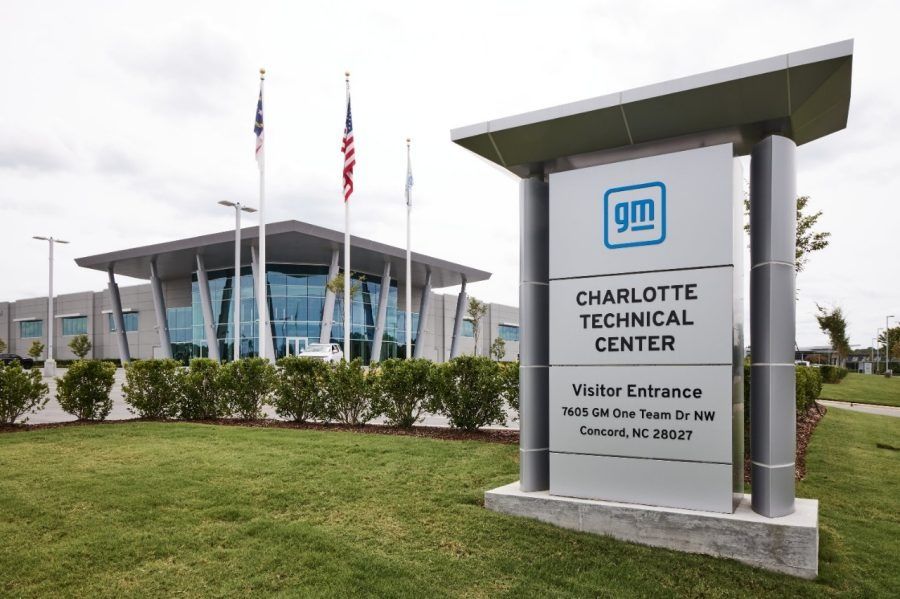
GM Charlotte Technical Centre
Photo by: General Motors
Becoming race ready
A state-of-the-art F1 simulator is currently being built as part of Cadillac’s brand-new headquarters in Fishers, Indiana. But until that building is fully up and running, the F1 team has done all of its driver-in-the-loop simulator work in North Carolina with a complement of experienced simulator drivers including Indy 500 winner Simon Pagenaud, two-time grand prix starter Pietro Fittipaldi and factory Corvette driver Charlie Eastwood.
That capability was a crucial piece in the puzzle of Cadillac’s Race Ready programme, an extensive preparation plan that included simulating various 2025 grands prix in real-time as if Cadillac was a virtual 11th team on the grid. For a squad that is comprised of over 400 experienced people, many of which had never worked together, it was an important way to start getting reps before making its real-life racing debut.
«We would genuinely not be here if we hadn’t had that GM facility in Charlotte last year,» said Pat Symonds, the veteran F1 engineer who has been tapped up as a senior engineering consultant to work alongside technical director Nick Chester. «Obviously, there’s the vehicle development side of it, which I have to say surprises me how good it is for that. But we were using it for our rehearsals. And we were running that simulator as if it was a racing car, and that was invaluable. I really think we would be nowhere near as race ready as we were without all of that.
«In many respects, GM are doing more than just running the simulator for us. Their whole vehicle performance group in Charlotte is really, really helpful to us. A lot of the software that we’re running is software developed by GM. We run a system called Race Vehicle Gateway, which is our database of everything for the cars. That’s something that was developed long before GM was going into F1. There’s elements of design that they do, and they work with us on things like thermal modeling and the AIML [artificial intelligence and machine learning] side of things, where we’ve got some pretty good projects going.»
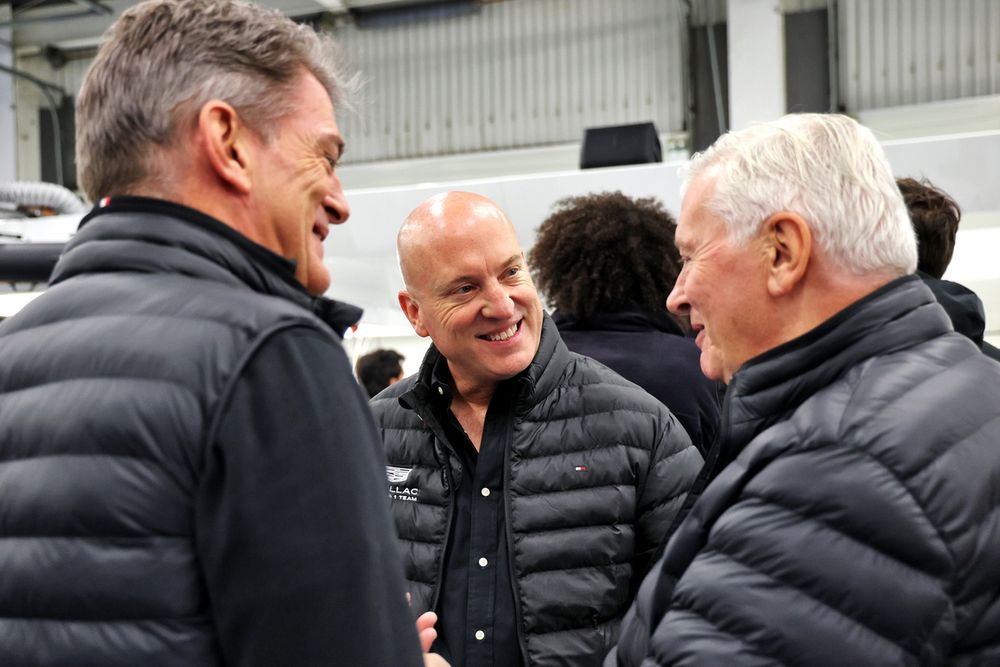
Graeme Lowdon, Dan Towriss, Pat Symonds, Cadillac Racing
Photo by: Cadillac Communications
One of the people tying Cadillac’s many departments together is head of performance analysis James Knapton, an engineer with a long career at the likes of Jordan/Force India, Sauber, Manor and Red Bull Advanced Technologies, where he worked on Adrian Newey’s Valkyrie.
«It was very good having GM, because we arrived in a place where they’ve got a set of simulation tools, models, solvers, and they’ve got a simulator we can tap into quite quickly,» Knapton added. «Otherwise those projects would have taken two or three years to evolve into working tools, so that gave us a head start straight away.
«The ability to cherry-pick from their skill set, which is actually across quite a range of different areas of engineering, has been super helpful. If we’d been just starting from scratch, we would have been further behind.»
Two-way tech transfers
Cadillac isn’t leaning on just GM for its driver-in-the-loop simulators, but also its knowledge and people. While a discipline like NASCAR may seem like a world away from F1 — and in many respects it is — it is often underestimated in Europe just how advanced the engineering behind the stock car series is. Its advanced tyre modelling is one key area that opened a lot of eyes, and some of that know-how is transferable.
«In a lot of ways it is, but it’s not true that everything that happens in F1 is the most technically advanced,» Warren explained. «You have the freedom in F1 to design more. It’s still a technical meritocracy. But in other series you’re playing in the margins of compliance. Take NASCAR, for example. A lot of people would think the car’s not [technologically advanced].
«It’s not about the car. It’s actually all the engineering that goes on behind it. And you look at the number of different tyres and different types of asphalt and tracks. It gives you a data-rich environment to work on how you thermally model.
«In F1 tyres are much simpler, because there’s five different tyres that you run all year and the level of asphalt changes is smaller. We have people that are aware of technologies and physical problems that even in F1, you may have never been exposed to. That allows us to maybe bring up some important ideas.»
«There is absolutely overlap,» said Symonds. «The head of our tyre science [Dr. Heather Bobbitt] is a GM employee, and she’s probably the best tyre scientist I’ve ever worked with. The models she’s developed are used throughout GM and by us, and we’re very happy with them.»

As expected, Cadillac has started its F1 adventure towards the back of the grid, but it hasn’t looked out of place
Photo by: Andy Hone/ LAT Images via Getty Images
Knapton added: «NASCAR tyre modelling is really quite advanced, and actually it’s been relatively painless porting the type of tyre models into F1 because they’re operating at F1 levels of modelling and development. But equally, on the vehicle-modelling side, they’ve got a really good group there. We’ve collaborated in quite a few different areas, including things like rig testing, a bit of aerodynamic work on brake duct design and aerothermal modelling for the cooling side.»
It’s not just one-way traffic though, and Warren is convinced that by being able to tap into F1’s high-tech ecosystem, its methodologies and its uniquely agile way of working, GM will benefit as a whole.
«What’s great about F1 is that there’s a lot of data on the car,» said Warren, who started his career as an aerodynamicist and subsequently a technical director in NASCAR. «The level of instrumentation and ability to understand how a car responds, that level of correlation is the biggest thing that F1 brings back to GM.
«You can run keel probe arrays to look at the aero wake behind a tyre, live in practice. Those things you couldn’t do in any other series practically or even by regulation. And as you grow the team to 400, 500 engineers, you might have one or two people that say: ‘Hey, I have this idea on how to model vehicle dynamics and how to do this optimisation’. That feedback loop becomes more in depth and you get more ideas that bounce around.
«So, I think it’s giving us the opportunity to mature the tools faster because there’s more data, more people looking at specific things. You learn how to deal with the amount of data and how to store that in the cloud, how different engineers can access that data quickly. Those are things that F1 helps advance.»
Building for the future
As tough as Cadillac’s F1 entry may have been, it is effectively only just the beginning of a long journey towards competitiveness. The US-owned team didn’t join F1 to make up the numbers, so in a cost-cap world it has to come up with a strategy to outsmart and outdevelop the establishment.
One pivotal pillar is its brand-new US headquarters that is currently being built in Fishers, Indiana, and which will complement its European outpost in Silverstone. «We have a new state-of-the-art simulator coming into Fishers, which should be online at the start of 2027,» Knapton said. «That should help our capability a lot. We’ve got new types of lap simulation solvers coming as well.
«The thing about F1 is that it’s often not a lot of big steps, but lots of little incremental gains in every area. Everything is always evolving all the time. We know in some areas, we’re not quite there with front-of-the-grid teams, we need to improve, so we’re just chipping away at everything and trying to improve the tools, while at the same time trying to design a car and take it racing as well.
«One of the phrases that were used here was trying to build a ship as you’re sailing it, and that’s not a bad analogy for what we’re trying to do.»

GM Charlotte Technical Centre
Photo by: General Motors
GM is also building an F1 power unit facility in Charlotte, which is still on course to deliver a V6 hybrid powertrain for 2029 but will also have to be ready for what may come next.
«It’s exciting to see that come to life,» said Warren. «We build engines for all kinds of vehicles, right? Not just our production vehicles and our high-performance production cars. We take great pride in that. So it’s central to us as an OEM, that’s part of our DNA.
«We’ve not been in F1, so seeing the level of testing and different technologies that we are developing with that programme, you immediately see how it’s going to be applied to production. That just makes us better as a company.
«We knew this coming in, but it just reinforces that we have to have ultimate respect for the challenge, make sure we’re building the foundation. We have to keep learning and earning it.
«Hopefully we can continue to be competitive and be able to recruit top talent and learn and grow. And we’ll get to where we need to get to. But they just don’t give those trophies out.»
We want to hear from you!
Let us know what you would like to see from us in the future.
— The Autosport.com Team


